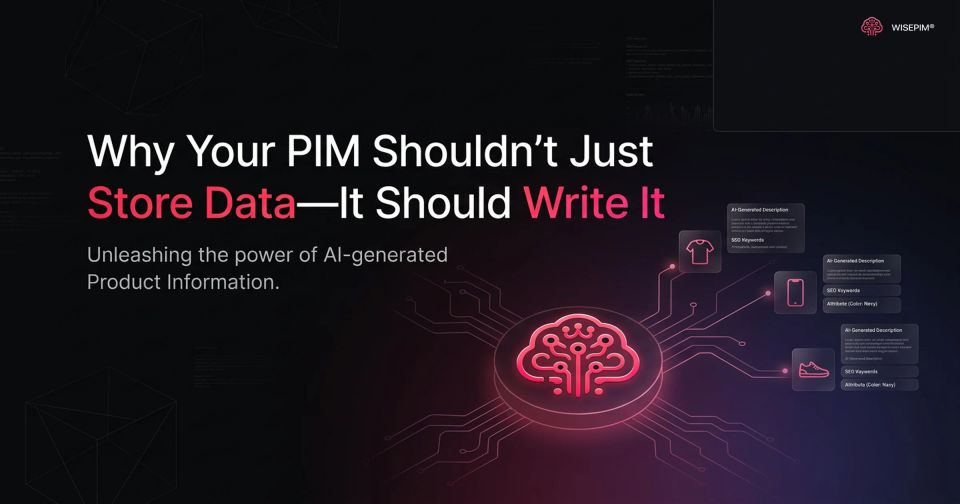
A 10,000-SKU catalog with 50 attributes per product generates half a million individual data points. If your team manages that volume using a traditional Product Information Management system, they are essentially operating a highly expensive, cloud-based filing cabinet. The software holds the information, but human operators still have to do all the heavy lifting to get it there.
By March 2026, the global PIM market is growing fast. Yet, e-commerce managers are still drowning in manual data entry. They wait weeks for translation agencies to localize content and spend hours tracking down missing technical specifications.
We are witnessing a structural shift in e-commerce architecture. The industry is moving away from passive data storage toward active content engines.
The Legacy PIM Bottleneck: Passive Storage
Traditional enterprise systems were designed for a different era of retail. Their primary function was governance. You imported a CSV of raw supplier data, and the system kept it organized.
These legacy platforms excel at complex ERP integrations for massive manufacturing conglomerates. They fail when agile e-commerce brands need to move fast. Deploying a traditional system often takes four to six weeks, requiring IT consultants and hefty setup fees starting well over €1,000.
Once installed, the operational burden remains entirely on your team. A copywriter still has to draft descriptions. Someone has to manually map attributes to Shopify or Amazon. Missing data fields—like exact package dimensions or material composition—stay blank until a human tracks down the manufacturer's PDF and types it in. Those blank fields directly damage search rankings and conversion rates.
Enter the AI-First PIM: Active Creation
An Ai First Pim operates on a completely different premise. It assumes the software should do the work.
Instead of waiting for a human to fill a blank field, modern platforms like WISEPIM actively hunt for the information. You feed the system raw EANs or SKUs. The built-in AI Web Research tool scours the internet, extracts the missing technical specifications, and populates the database automatically.
This fundamentally changes catalog management. Your team transitions from data entry clerks to strategic editors.
Nasry Angel of Forrester Research framed the current market perfectly: "Today is the age of the customer... Customers want to be treated like celebrities." They expect Amazon-level filtering accuracy and rich, engaging content on every single product page. Meeting that expectation manually across thousands of products is mathematically impossible for most mid-market teams.
Head-to-Head: Where Traditional Systems Fail
Comparing a legacy database to an active content engine reveals stark differences in daily operations.
Legacy PIM and AI-first PIM side by side
| Core job | Governance: stores and organizes imported supplier data | Does the work: researches, writes and enriches |
|---|---|---|
| Missing fields | Stay blank until someone types them in from the manufacturer's PDF | AI Web Research finds missing specs from raw EANs or SKUs |
| Data import | Format spreadsheets and match column headers first | AI-powered mapping normalizes messy supplier feeds |
| Titles and descriptions | A copywriter drafts each one | Generated from your brand's Knowledge Library |
| Translation | Agency work that delays launches by months | Translation into dozens of languages in the system |
| Multiple channels | Custom middleware formats data per endpoint | Tone, length and formatting adjusted per channel |
Data Ingestion and Enrichment
Old methodology requires extensive data cleansing before an import even begins. You format spreadsheets, match column headers, and pray the upload does not fail.
The modern approach handles messy data natively. AI-powered mapping reads disparate supplier feeds and normalizes the information. From there, the system applies your brand's specific Knowledge Library to auto-generate SEO-rich titles and descriptions. What used to take a copywriting team weeks now happens in minutes. This level of product data enrichment is no longer a luxury; it is a baseline requirement for visibility.
The Translation Trap
Entering the German or French market traditionally means hiring an agency. This delays product launches by months and drains marketing budgets. Active PIM systems translate catalogs into dozens of languages natively and in real-time. You launch internationally the moment your logistics are ready, not when the translation agency finally returns your files.
The Composable Commerce Imperative
Modern e-commerce requires flexibility. Brands push data to Shopify, Amazon, B2B portals, and POS systems simultaneously.
Legacy systems often struggle with this multi-channel reality, requiring custom middleware to format data for different endpoints. An Api First Pim is built for composable commerce. It acts as an absolute single source of truth, automatically adjusting the tone, length, and formatting of your product data to match the specific requirements of each downstream channel. Achim Beckmann, Managing Director at In Mind Cloud, notes that this automatic synchronization eliminates failure costs entirely.
The Accuracy Elephant in the Room
Skeptics correctly point out the risks of automated content generation. AI hallucinations are a real threat to e-commerce accuracy. If a system invents a waterproof feature for a standard canvas shoe, your return rate will spike, and your customer trust will evaporate.
Inriver's 2025 AI in PIM research found that while 87% of companies report increased customer trust in their product content since adopting AI, 90% still run into occasional accuracy issues. This is exactly why plugging a generic AI wrapper into a legacy database is dangerous.
Reliable automation requires strict data validation. WISEPIM uses Quality Guard, a rules-based quality check that flags incomplete or inconsistent product data before you publish it. The AI generates content from your product data and technical specs, and your team reviews the output and decides what goes to your sales channels.
The Financial Impact of Velocity
The difference between passive storage and active creation shows up immediately on the balance sheet.
When routine descriptions are generated from structured data, a team stops writing them by hand and can focus on high-margin merchandising strategies. This is the reality of effective catalog scaling.
The same logic holds at scale: richer, accurate product information tends to lift conversion and cut returns. When customers know exactly what they are buying, they buy more and return less.
If your team is spending hours formatting spreadsheets or manually hunting down product weights, your technology is failing you. Your PIM should not just store your data. It should write it, enrich it, and syndicate it.
Stop paying for a filing cabinet. Upgrade to an engine.