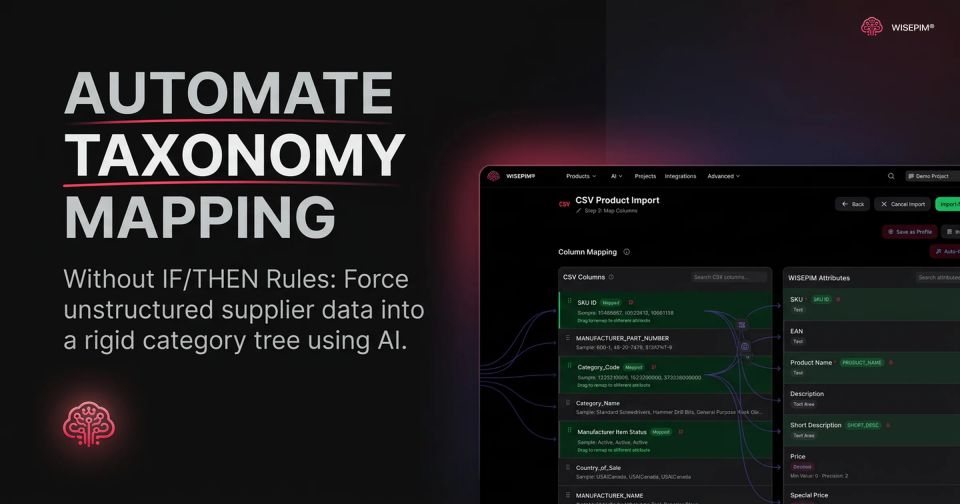
Disconnected systems and data silos cost e-commerce businesses real revenue. Much of that leakage happens at the very beginning of the catalog lifecycle: trying to force messy, unstructured supplier data into a rigid category tree. Take the UK grocery sector right now in 2026, where a large share of sales comes from private labels that often lack universal product IDs like GTINs or EANs. You cannot rely on a barcode lookup. You have to read the description, understand the context, and map it accurately.
Legacy operations handled this with massive, fragile spreadsheets. Modern e-commerce teams automate it.
The global PIM market keeps growing, driven largely by the shift from manual data entry to automated, semantic understanding. Retailers with clean, AI-driven taxonomies get more out of faceted search, simply because their filters actually work.
Here is exactly how to stop writing manual rules and start automating your product classification.
The Death of the Dependency Table
For years, mapping supplier data to your internal Product Taxonomy meant writing endless IF/THEN statements. If the title contains "shirt," map to "Apparel." If the description contains "length 50 cm," extract "50" and map to the "Length" attribute.
This rules-based approach breaks the moment a supplier sends "iPhone 12 64GB Blue" and another sends "Apple iPhone 12 - 64 GB, Color: Blue." Legacy systems treat those as two different SKUs. Your inventory fragments. Duplicate listings appear.
The industry has moved to Large Language Models (LLMs) and Natural Language Processing (NLP). These models understand semantic context. They know that "athleisure" maps to "yoga pants" or "activewear" without needing a human to explicitly build that connection. This shift effectively eliminates the need for manual Product Data Transformation Rules that require constant maintenance.
Step-by-Step: Automating Taxonomy Mapping
Automating your classification requires a specific sequence of operations. Skipping straight to the AI model usually results in confident hallucinations.
The four-step sequence for automated taxonomy mapping
Step 1: Preprocess and Standardize Input Data
Data scientists in the e-commerce space will tell you that cleaning input data boosts matching success far more than upgrading to the latest AI model.
Retailers receive product data in wildly inconsistent formats. You might get a messy Excel sheet from one vendor and a poorly formatted XML feed from another. Before any mapping occurs, run a preprocessing script to strip out HTML tags, standardize units of measurement (converting "inches" to "in"), and normalize text casing. Clean data gives the classification engine a clear baseline.
Step 2: Deploy Multimodal Context Extraction
Relying solely on text is a mistake. The most advanced systems use multimodal AI to analyze product titles, descriptions, supplier images, and customer reviews simultaneously.
If a supplier description simply says "Classic Blue V-Neck," the text model might map it to men's t-shirts. By analyzing the accompanying supplier image, a multimodal model recognizes it as a women's cashmere sweater. Combining visual analysis with text processing catches mismatches that text alone misses.
Step 3: Execute Semantic Attribute Mapping
Once the context is established, the system maps the extracted data to your specific hierarchy. Tools like getName.ai operate as "mapping killers" in this phase.
Instead of relying on rigid tables, a Semantic Pim reads a phrase like "water resistance up to 50m" and automatically assigns it as a numerical attribute with a unit to the correct database field. This is particularly critical when mapping unstructured supplier data directly into global standards like GS1, ECLASS, or Etim for electrotechnical goods. The AI understands the destination requirements and formats the data to fit.
Step 4: Implement the Human-in-the-Loop Workflow
AI is a power tool, not magic. It excels at first drafts at scale and handling repetitive formatting. It lacks domain judgment for complex edge cases.
The prevailing operational framework is Human-in-the-Loop (HITL). You configure the system to automate 95% of the catalog mapping based on high confidence scores. The remaining 5% of ambiguous products are automatically routed to human merchandisers for review. Native services like SAP AI Data Attribute Recommendation attach a confidence score to every prediction, telling your team exactly when to trust the machine and when to verify the output.
The ROI of Automated Mapping
Theoretical frameworks only matter if they produce tangible business outcomes.
Consider LemonMind, an agency that recently executed a massive PIM migration. Their client needed to move 500,000 products from a deprecated category structure into a newly refreshed taxonomy. Manually re-classifying half a million SKUs takes months. Using AI, they automated the mapping process with a 95% efficiency rate. That left only 25,000 edge-case products for human review, saving thousands of manual labor hours.
Amantra, a global retailer with over 1 million SKUs, faced a similar bottleneck with incomplete supplier uploads. They implemented an LLM-based classification engine that parsed unstructured text, enriched missing metadata, and assigned categories contextually. The system successfully handled their multilingual catalog and adapted to seasonal taxonomy shifts without requiring a single manual rule update.
When a customer filters your site by "Waterproof" and a jacket is missing that attribute tag, it effectively does not exist. That is pure revenue leakage. Implementing AI-driven Attribute Mapping closes that leak and cuts a large share of manual category mapping work.
The Reality Check: Limitations and Liabilities
Automation carries risks. You need to understand them before deploying these systems at scale.
Skeptics correctly point out the "garbage in, garbage out" reality. AI models are highly dependent on training data. If a supplier's input data is fundamentally flawed, the AI will confidently misclassify the product.
Furthermore, generalist LLMs suffer from severe B2B domain ignorance. In specialized sectors like electrical components, building supplies, or medical devices, AI often misunderstands technical jargon. A misclassified consumer t-shirt is a minor annoyance. A misclassified industrial chemical or electrical switch is a severe compliance liability.
Finally, abandon the "set and forget" myth. E-commerce taxonomies are dynamic. As new product categories emerge—like a novel tech gadget category that didn't exist twelve months ago—the models require retraining and governance.
Stop treating product categorization as a backend IT task. It is the foundation of faceted search, SEO markup, and revenue generation. Automating your mapping processes turns complex data management into a simple, scalable operation, transforming your catalog from an operational burden into a sharp competitive edge.