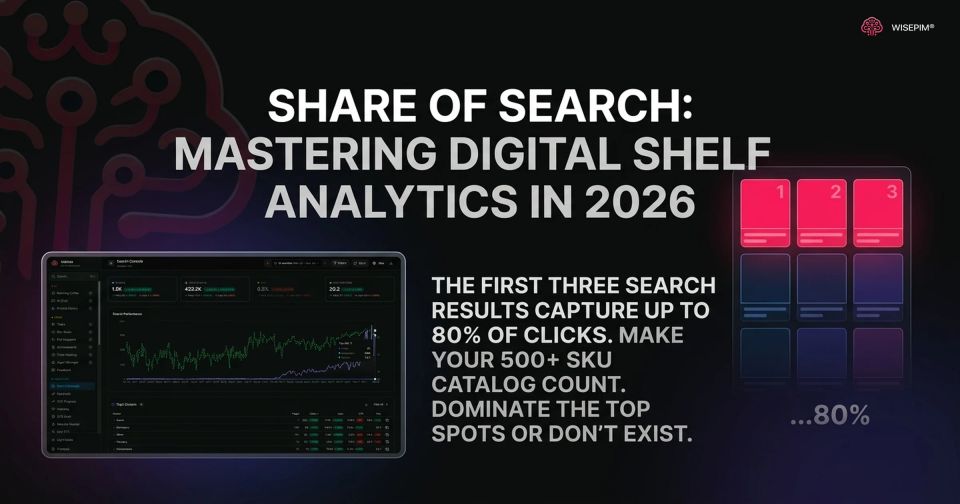
On major retailer sites, the first three products to appear in search results capture up to 80% of all clicks. If your 500-SKU catalog isn't dominating those top spots, your inventory effectively does not exist.
The global Digital Shelf Analytics market hit $1.68 billion in 2025 and shows no signs of slowing. Brands are pouring millions into tracking software. Yet, many e-commerce managers still spend their mornings staring at red dashboards, manually downloading CSVs to figure out why a flagship product suddenly dropped from rank #2 to #45 on Target.com.
Knowing you have a visibility problem is useless if you lack the infrastructure to fix it before your competitor steals the buy box.
Share of Search (SoS) is the New Market Share
Industry leaders in 2026 have abandoned traditional market share calculations for a more ruthless metric: Share of Search. The logic is uncompromising. If a product fails to appear on the first page of search results, it does not make its way to the cart.
Direct e-commerce sales figures are deceptive. While direct online transactions accounted for roughly 16.3% of all retail sales in mid-2025, the Digital Shelf influences overall retail purchases at a rate three times larger. A shopper checks prices on their phone while standing in a physical aisle. They read a review before picking up a box off a pallet.
AI-driven referrals to retail sites spiked by over 500% year-over-year during the 2025 holiday season. Conversational commerce assistants do not offer a shopper three pages of options. They offer one or two highly optimized recommendations, making top-tier placement an absolute necessity.
The Out-of-Stock Death Spiral
Algorithm volatility across retailers remains a massive headache for practitioners. What optimizes a product on Amazon might actively penalize it on Instacart.
One universal truth remains across all algorithms: the out-of-stock (OOS) death spiral.
When a product goes out of stock even briefly, its organic ranking plummets. Supply chain teams eventually resolve the inventory hiccup, but the digital damage is done. The listing sits buried. Practitioners struggle for weeks to recover the lost organic rank, often resorting to expensive retail media campaigns just to buy back their previous position.
Beware the "Dashboard of Doom"
Buying a tracking tool without a connected execution system creates what skeptics call the "dashboard of doom."
Relying on a standalone monitoring platform means your team gets real-time alerts about pricing violations, broken images, or OOS issues. But if those same practitioners have to open siloed Word documents or route tickets to an IT backlog to update a listing, the insight is wasted. Digital shelf analytics without Product Information Management Pim integration is just expensive noise.
Marshall Group (formerly Zound Industries) recognized this bottleneck. Before integrating their downstream visibility tools, gathering performance data was a manual slog taking a week or more. By connecting their analytics directly to their product data workflows, they achieved real-time insights into ranking shifts and content execution.
The 2026 Standard: The Measurement Loop
The baseline expectation for e-commerce teams is now a unified, closed-loop system.
Analytics tools act as the sensory network. They detect when a competitor drops their price by 5% or when a primary image breaks on a retailer site. That detection automatically triggers a routing workflow inside the PIM. Teams review the flagged issue, apply the necessary Product Content Optimization, and syndicate the corrected data back to the channel.
This continuous cycle—Detect, Route, Syndicate—turns lagging metrics into real-time action.
Advanced computer vision has driven the hyper-automation of compliance within this loop. Brands previously relied on inaccurate sampling, checking a few random online stores to measure compliance. Now, policy-driven workflows monitor thousands of SKUs continuously, replacing costly manual audits with immediate corrections.
The Content Imperative in the Barbell Economy
We are currently operating in a "Barbell Economy." Consumers expect either full-price exclusivity or deep-discount liquidation. The moderate discount is dead. Brands are actively using analytics to monitor this barbell effect, ensuring their pricing strategies do not fall into the mid-market dead zone.
Surviving this environment requires flawless execution. Google reports that 85% of shoppers state product information and pictures are the deciding factors when choosing a brand. A beautifully optimized detail page is mandatory, but it must be paired with absolute price integrity and regional availability. A perfect product description is useless if a competitor's algorithmic pricing undercuts you by 5%.
Amy’s Kitchen learned this firsthand. They previously relied on fragmented data across brand and digital teams, using manual documents to submit product info. By unifying their product data and syndication, they established a single source of truth. This automated their workflows and ensured complete, optimized content across every digital touchpoint.
Stop Renting Your Visibility
Organic reach is increasingly difficult to maintain. Retail Media Networks (RMNs) have turned visibility into a rented space.
Aligning your paid retail media efforts with organic Search Engine Optimization Seo requires an agile Product Feed Optimization strategy. You cannot afford to run paid ads to a listing with a broken title or an outdated feature bullet.
The digital shelf is no longer an operational burden left to a junior merchandiser. It is the primary battleground for market share. Connect your analytics to a robust product content platform, automate your compliance workflows, and turn complex data management into a definitive competitive edge.