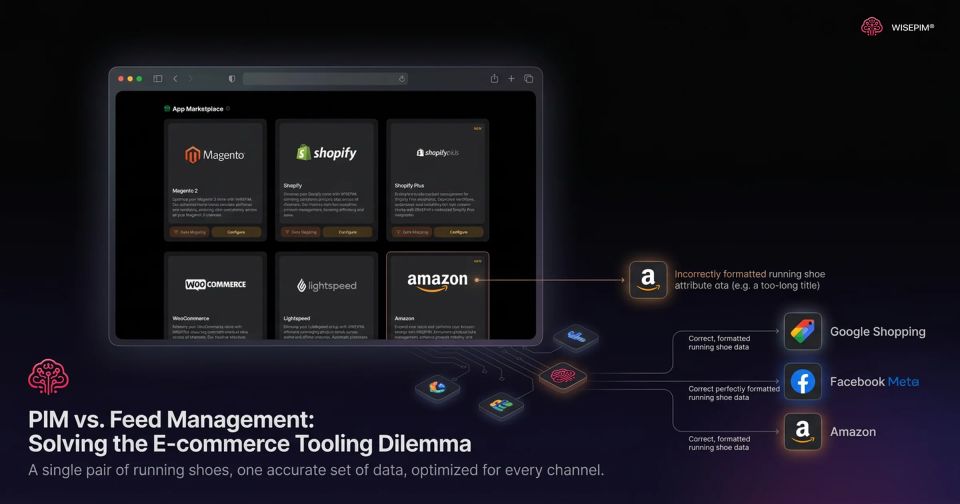
A single pair of running shoes sold across Google Shopping, Amazon, and Meta requires three entirely different sets of attributes. Google wants specific title lengths. Amazon demands strict image ratios. Meta requires unique categorization rules. When e-commerce teams try to manage this matrix manually, listings get rejected and revenue stalls.
This operational friction is why brands eventually abandon manual data entry. US e-commerce sales reached $1.11 trillion back in 2023, and the sheer volume of digital sales has forced a reckoning in how companies handle product information.
Buyers looking to fix their data bottlenecks usually end up evaluating two distinct software categories: Product Information Management (PIM) and Product Data Feed Management. While vendors often blur the lines between them, understanding their architectural differences is the only way to build a tech stack that scales.
The Core Architectural Divide: Inward Governance vs. Outward Agility
The fundamental distinction comes down to software architecture and primary function.
PIM systems are built for inward governance. They handle workflow approvals, data enrichment, and creating a unified catalog. Their job is to ensure that a 500-SKU catalog with 40 attributes per product—resulting in 20,000 distinct data points—remains perfectly accurate and standardized.
Feed tools are built for outward agility. They rapidly transform existing data to meet the constantly changing API requirements of thousands of global marketplaces and advertising networks.
Industry practitioners often use a restaurant analogy to explain the relationship. Your PIM is the kitchen. It is where you organize the recipe, source the ingredients, and bake the cake perfectly. The feed management system is the delivery driver. It slices the cake and drops it off at different houses based on highly specific dietary requests.
PIM vs. feed management at a glance
| Primary job | Inward governance: approvals, enrichment, one unified catalog | Outward agility: reshaping data for each marketplace and ad network |
|---|---|---|
| Restaurant analogy | The kitchen | The delivery driver |
| Typical win | Flags a missing weight attribute before Amazon rejects the listing | Truncates long titles and maps categories to Google's taxonomy |
| Price and stock sync | Rarely built for high-frequency syncing | Real-time API connections keep price and stock current |
| Main limitation | Needs upfront data modeling of your taxonomy | Cannot fix bad core data: garbage in, garbage out |
| You need it when | Your team spends 20 hours a week updating spreadsheets | Your listings get rejected over formatting rules |
Product Information Management (PIM): The Single Source of Truth
A Product Information Management Pim platform acts as your operational baseline. Practitioners generally seek out these tools when they hit the "spreadsheet ceiling." As SKU counts grow into the thousands, managing product data via Excel becomes a massive resource bottleneck, leading to formatting inconsistencies, missing fields, and delayed time-to-market.
Advantages of a PIM
Centralizing your catalog provides immediate structural benefits:
- Standardized Data Quality: A PIM centralizes Product Data Quality before it ever reaches an external channel. If a weight attribute is missing, the system flags it internally rather than waiting for Amazon to reject the listing.
- Automated Enrichment: In 2025 and 2026, AI transitioned from a premium add-on to a baseline requirement. Modern PIMs actively use AI to generate channel-specific marketing copy and auto-categorize massive catalogs.
- Workflow Control: PIMs allow distinct user roles. Copywriters can edit descriptions while compliance officers approve technical specifications, completely eliminating the chaos of shared spreadsheets.
Limitations of a PIM
- Not Built for High-Frequency Syncing: While PIMs store data beautifully, they are rarely designed to handle the complex, real-time inventory and price syncing required for high-frequency ad bidding on Google Shopping.
- Upfront Data Modeling Required: You cannot simply dump messy data into a PIM and expect miracles. The system requires thoughtful configuration of your product taxonomy first.
Product Data Feed Management: The Distribution Engine
Once your data is clean, a Product Feed manager takes over. Historically, marketing teams relied heavily on IT departments to configure XML or JSON feeds for new channels. Marketers experience immense friction when they cannot independently map data to new advertising networks.
Modern feed managers—like Channable or Feedonomics—allow marketers to use rule-based automation to map data independently.
Advantages of a Feed Manager
- Prevents Channel Rejections: A feed tool automatically truncates titles that exceed character limits or maps your internal "Apparel" category to Google's highly specific "Clothing & Accessories > Shoes" taxonomy.
- Real-Time Inventory Sync: Feed management with real-time API connections prevents outdated pricing and stock data. This stops overselling, which otherwise leads to canceled orders and severe marketplace penalties.
- Speed to Market: Global marketing agencies use feed tools to bring distribution in-house. By removing IT from the critical path, marketers can launch a new Marketplace Listing in hours instead of weeks.
Limitations of a Feed Manager
- Garbage In, Garbage Out: A feed manager does not fix bad core data. If your product lacks a material attribute in your database, the feed manager cannot magically invent it. It only distributes what you feed it.
- Fragmented Truth: If you use a feed tool to actively edit core product descriptions rather than just formatting them, you create a scenario where the data on your website no longer matches the data on your ad channels.
The "All-in-One" Convergence Myth
Software vendors frequently market built-in syndication capabilities, suggesting you can bypass buying two separate tools. The January 2025 Gartner Market Guide for PIM Solutions noted that standalone PIMs are evolving into broader experience platforms.
Enterprise reality tells a different story. Buying a single tool to do both often results in compromised functionality. A $50,000 enterprise PIM might have a basic feed exporter, but it will lack the granular, real-time API connections of a dedicated feed tool. Conversely, using a feed manager to hack together a central catalog leads to terrible data governance.
Brands operating within the modern MACH (Microservices, API-first, Cloud-native, Headless) architecture prefer composable commerce. They deploy an API-first PIM as the central hub, plugging it directly into specialized feed engines.
How to Sequence Your Tech Stack in 2026
Retail executives generally agree on a strict implementation hierarchy: start with the PIM, then add a feed manager only if your Channel Management complexity demands it.
Which tool to add first
Feeding messy, incomplete product descriptions into a high-speed distribution tool just means you publish bad data faster. You must establish a single source of truth first.
At WISEPIM, we built our platform to solve the foundational layer so efficiently that it feels like cheating. By applying AI directly to the enrichment and categorization process, we ensure your feed tools always have perfect, standardized data to pull from. You stop treating feed mapping as a cleanup exercise and start using it strictly for distribution.
If your listings are getting rejected because of formatting rules, you need a feed manager. If your team is spending 20 hours a week manually updating spreadsheets just to figure out what a product actually is, you need a PIM. Master the kitchen first, then worry about the delivery route.