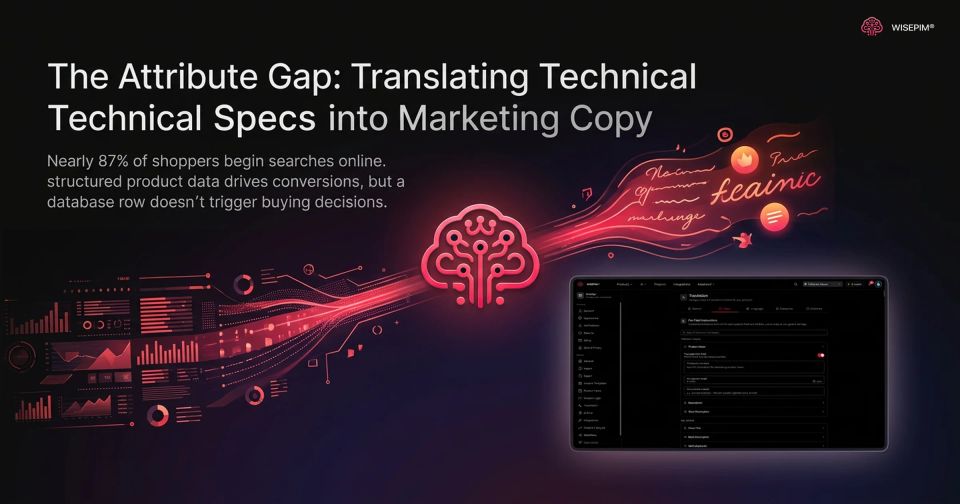
Nearly 87% of shoppers begin their product searches online. Those who utilize site search are two to three times more likely to convert than casual browsers. That conversion pipeline relies entirely on structured product data, but a perfectly formatted database row doesn't trigger an emotional buying decision.
Bridging the gap between raw technical specifications and persuasive marketing copy is the most persistent bottleneck in e-commerce merchandising. A 500-SKU catalog with 40 attributes per product means 20,000 individual data points that a team has to keep accurate. Usually, this data originates in an ERP system built for warehouse logistics, not human beings. You receive dry, clinical specs like `Material: 100% Cotton`, `Fit: Relaxed`, and `Weight: 200g`.
Marketing teams are then forced to manually translate these sterile facts into compelling copy. It is an operational nightmare that drains resources and fractures brand consistency.
The Spreadsheet Chaos of Supplier Onboarding
The disconnect deepens when you factor in supplier onboarding. Vendor data is notoriously messy. Supplier A lists a television's size as `55"`, Supplier B writes `55-inch`, and Supplier C inputs `139cm`.
Without strict attribute mapping, your site search breaks immediately. Customers cannot filter accurately. They get frustrated and leave. Content teams end up spending hundreds of hours a month acting as highly-paid data entry clerks, normalizing vendor spreadsheets instead of writing copy that actually sells.
Audience fragmentation multiplies this workload. A B2B buyer needs a product description heavily focused on technical specifications and compliance. A B2C buyer looking at a consumer-grade version of that same product needs creative, lifestyle-focused copy. Manually writing multiple variations of copy for the exact same product attributes is unsustainable for any growing brand.
The Fact vs. Fiction Merchandising Framework
Industry experts point to a strict dividing line in digital merchandising: attributes provide facts, while descriptions paint pictures.
Shoppers filter a category page using hard product attributes like "Weight: under 2kg" or "Color: Navy." They actually click the buy button because the copy promises the jacket is "perfect for lightweight travel."
This framework dictates a non-negotiable rule. Marketing copy must always be a downstream derivative of locked, objective attributes. Never the reverse. When marketing teams write creative fluff that isn't firmly anchored to verified technical specs, customers receive items that fail to meet their expectations. Return rates spike, and profit margins evaporate.
Enter the AI-Driven Translation Engine
We are well into 2026, and the e-commerce software market has shifted. The industry has moved rapidly from basic AI-powered tools that merely automate spellcheck to AI-driven platforms that dynamically translate data flows.
Generative AI models are now natively ingesting dry, structured data and instantly outputting channel-specific marketing attributes. Deloitte Digital's April 2025 report, Empowering PIM with GenAI, highlighted that product information is inherently fragmented along the product lifecycle. Integrating large language models with traditional PIM architecture is the primary way commerce leaders respond to competitive pressures today.
Consider a recent case study involving Hexaware Technologies and Google Cloud. A major furniture retailer struggled with low conversions because their product descriptions were buried in technical jargon. By implementing a GenAI solution, the system ingested raw database metadata, extracted the necessary specs for site filtering, and generated highly tailored copy. It automatically created dense, technical copy for their B2B portal and lifestyle-focused copy for their B2C site—all from the exact same dataset.
Visual Extraction Ends Manual Tagging
The days of merchandisers manually typing out "floral," "midi," and "v-neck" are over. Computer vision tools now scan supplier images and automatically generate structured attributes.
If a vendor uploads a photo of a shirt, AI platforms like Pixyle scan the visual elements, populate the PIM fields, and achieve data completeness without a single keystroke. This structured data immediately feeds the front-end marketing copy. The text perfectly matches the visual reality of the garment, eliminating the discrepancy between what the customer reads and what they see.
Global localization follows the same automated path. Modern PIM platforms integrate with AI tools to not just generate descriptions, but to localize them dynamically. A core set of product attributes generates SEO-optimized marketing copy tailored to specific regional markets. The system automatically adjusts for local search trends and cultural nuances, saving localization teams thousands of hours.
The Confident Garbage Trap
Skeptics correctly point out that AI is a double-edged sword. If your underlying data is messy, outdated, or missing entirely, the AI will confidently hallucinate marketing copy that is factually false. AI cannot fix a fundamentally broken data governance strategy. It only scales it.
This is why a Human-in-the-Loop workflow remains critical. Merchandisers must maintain absolute control over the taxonomy. You use the AI for the heavy lifting—attribute extraction, data normalization, and first-draft generation—while human copywriters refine the emotional hook.
Over-optimizing technical specs into your front-end copy kills discoverability. You want structured data in the backend for search algorithms, translating only the specific benefits of those specs into the rich product content your customers actually read.
Turning Data Into a Competitive Edge
Turning complex data management into a simple, one-click operation is the only way to scale an e-commerce catalog. Product content needs to stop being an operational burden. By locking down your technical attributes and letting an AI-driven PIM handle the translation into marketing copy, you turn raw data into a measurable competitive edge.
WISEPIM builds tools that let you create this exact workflow so fast it feels like cheating. Stop manually rewriting ERP data, and start generating product experiences at scale.