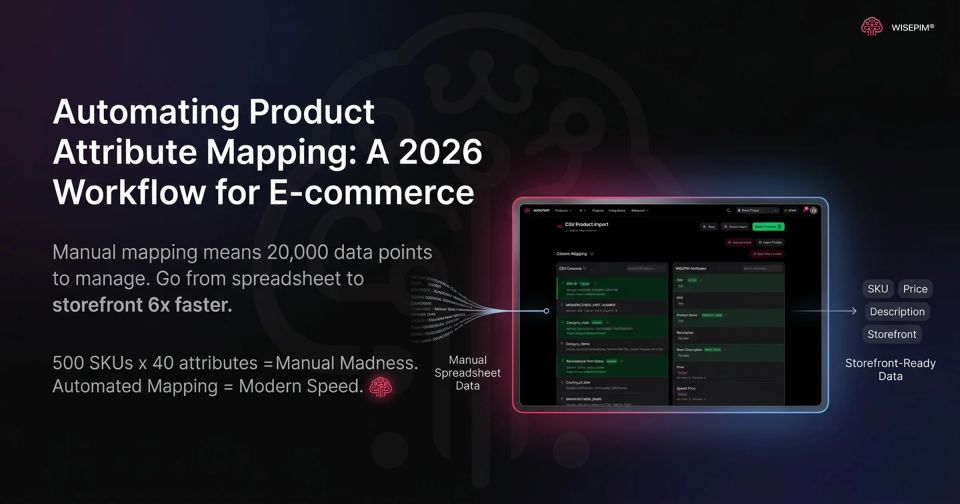
A 500-SKU catalog with 40 attributes per product means 20,000 individual data points that someone has to keep accurate. If your team relies on manual spreadsheet processes to map those fields from supplier feeds to your storefront, you are operating far slower than competitors using dedicated systems. Poorly mapped data directly causes zero-result searches, triggering immediate site abandonment.
Retailers receive information from hundreds of vendors in wildly different formats. One supplier delivers a pristine CSV file using the column header "Composition." Another sends a PDF where the fabric type is buried deep within a massive text block. A third uses an API feed that labels the exact same data point as "Material."
Resolving these discrepancies is the core of attribute mapping. It requires translating incoming vendor jargon into your internal product taxonomy, and then re-translating that data for external endpoints like Shopify or Amazon.
Building a Resilient Mapping Matrix
Before touching any software, you need a centralized mapping matrix. This document acts as the translation layer for your entire catalog operation. It defines exactly how external data points convert into your internal schema.
A practical matrix includes the source field name, the target internal attribute, the accepted data format, and any transformation rules. If a supplier provides weight in ounces, but your storefront displays grams, the matrix dictates the conversion formula. Establishing these rules upfront prevents downstream errors that confuse buyers and inflate return rates.
Sample mapping matrix rows built from the examples in this post
| "Composition" | CSV column header | Material | Map header to Material |
|---|---|---|---|
| Fabric type inside a text block | Supplier PDF | Material | Extract the value from the text |
| "Material" | API feed field | Material | Map field to Material |
| Weight in ounces | Supplier feed | Weight (grams) | Convert ounces to grams |
| "Small", "s", "S" | Supplier feeds | Size | Normalize to "S" |
| "Navy/Midnight" | Internal ERP | Amazon Color Map | Send "Blue" |
The Over-Engineering Trap
Catalog managers frequently fall into the trap of over-engineering their schemas. They build 50 custom fields for a single category, only to realize customers exclusively filter by five: Price, Size, Color, Brand, and Material.
Bloated schemas waste database resources and severely bottleneck the onboarding process. When mapping attributes for scalability, focus on the fields that actively drive semantic search and facet filtering. Modern e-commerce search engines rely heavily on intent. If a user searches for "eco-friendly laptop bag," the engine maps that query to structured attributes like "sustainable" or "recycled material." If you mapped that supplier data into a generic text description instead of a specific product attribute, your product will not appear in the results.
Resolving Taxonomy Mismatches Across Channels
Mapping a master catalog to different sales channels introduces another layer of complexity. Your internal ERP might list a jacket color as "Navy/Midnight," but Amazon requires a strict "Color Map" value of "Blue."
Failing to map these variations correctly breaks parent-child product relationships. Consider integrations pulling data from platforms like AliExpress into backend systems like Odoo. Extracting a single SKU's size, color, and style into a structured variation hierarchy requires precise mapping rules. Without them, you end up with fragmented listings. Businesses that prioritize accurate mapping set correct customer expectations, and that means fewer product returns.
The Shift to Automated Ingestion
The industry has moved past basic rules-based mapping. By early 2026, a growing share of organizations use AI for product data enrichment and intelligent field mapping.
Instead of writing complex regex formulas to parse vendor data, modern tools use Natural Language Processing to ingest unstructured text. You can drop a raw supplier PDF into a system, and the AI parses the document, normalizes inconsistent values (converting "Small," "s," and "S" into a standardized "S") and maps them directly to your predefined database tables.
WISEPIM applies the same idea to managing attributes. AI enrichment reads your product titles, descriptions and supplier data and fills the right values into the right attribute fields, and imports map supplier columns to your own fields. You skip the manual copy-pasting entirely.
Why Human Validation Remains Necessary
Total automation is a myth. Relying entirely on AI without human-in-the-loop validation inevitably leads to costly catalog errors. An automated system might misinterpret a "10-pack" packaging attribute as a single item price, destroying your profit margin on that SKU.
Smart mapping workflows use AI to do the heavy lifting—extracting and standardizing the raw data—while catalog managers handle product data validation. You review the AI's proposed mappings, approve the accurate ones, and correct the exceptions. This hybrid approach drastically reduces manual review cycles while maintaining perfect data integrity.
Hybrid attribute mapping: AI proposes, catalog managers decide
Regulatory Pressures: The EU DPP
Attribute mapping is no longer just a marketing function. The broader implementation of the European Union's Digital Product Passport (DPP) throughout 2026 has transformed data governance into a strict legal compliance requirement.
Brands selling in the EU must now track and disclose hyper-detailed attributes regarding product sourcing, repairability, and environmental impact. You cannot manually track this volume of granular data across thousands of SKUs. Automated mapping pipelines are mandatory to extract compliance data from manufacturer specs and push it to the required regulatory formats.
Stop Mapping Manually
Manual attribute mapping is the primary bottleneck for new product launches. By automating how you ingest and route vendor data, your team shifts from a defensive posture of constantly fixing errors to an offensive strategy of launching SKUs faster.
Turn your complex data management into a simple operation. WISEPIM lets you create and map product content so fast it feels like cheating. Start routing your vendor data intelligently and reclaim your team's time.