Google processes over one billion shopping sessions daily. At Google I/O in May 2026, the company fundamentally altered how those sessions end. The introduction of the Universal Cart means consumers no longer need to click through to your website, navigate your category pages, or manually enter their credit card details. Instead, an AI agent handles the checkout across multiple distinct retailers simultaneously in the background.
Many analysts immediately framed this as a disaster for direct-to-consumer brands, warning about the loss of top-of-funnel traffic. I see it differently. The shift toward agentic commerce is the greatest equalizer e-commerce has seen in a decade. It moves the competitive battleground away from expensive website redesigns and directly onto the quality of your product data.
Bypassing the Front Door to Win the Sale
Traditional conversion rate optimization relies on human psychology. You test button colors, tweak lifestyle imagery, and manipulate layouts to keep a shopper engaged. Agentic commerce removes the human from the final transaction layer. When a user tells Gemini to find and purchase a specific running shoe under a certain price, the AI does not care about your beautifully designed homepage.
It cares about the Universal Commerce Protocol (UCP). This open standard allows agents to securely discover items, verify stock, and initiate checkouts. Major retailers like Sephora, Walmart, and various Shopify merchants are already supporting UCP-powered transactions.
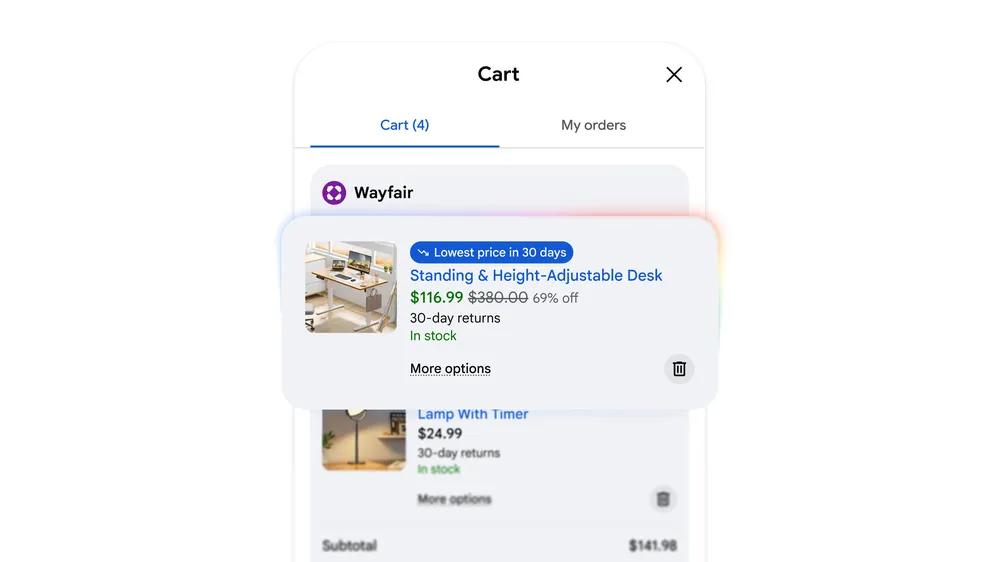
If a customer adds a product to their cart from a YouTube video, the agent tracks price drops and restocks autonomously. Your brand remains the merchant of record. You handle fulfillment and own the customer data. The visual storefront is simply bypassed. This levels the playing field. A mid-sized retailer with perfectly structured specifications can out-compete a massive enterprise with messy, unstructured data.
The Mechanics of AI Agent Relevance
Large language models hallucinate when they lack context. If your Product Content consists of a single paragraph of marketing text with technical specs buried inside, an AI agent will ignore it. It cannot risk recommending an incompatible item to the user.
Executives demonstrated this exact scenario during the Google I/O keynote. A user building a custom PC added components from three different retailers to their Universal Cart. Gemini instantly flagged that the chosen motherboard had the wrong socket type for the CPU. It then suggested a compatible alternative from a completely different retailer.
That fourth retailer won the sale without spending a dime on traditional ads. They won because their Product Catalog clearly defined the socket type attribute in a structured format the AI could instantly parse. Discoverability now relies entirely on machine-readable accuracy.
Escaping the Automated Margin Trap
Skeptics point out that AI agents ruthlessly comparing prices will drive deflationary pressure on consumer goods. If Gemini tracks a competitor dropping their price by five percent, it instantly notifies every user holding your product in their Universal Cart.
Competing purely on price in an agentic environment is a race to the bottom. The antidote is rich, highly specific product data that justifies premium positioning. When an AI evaluates a $150 jacket against a $90 jacket, it looks for differentiating attributes. Does the $150 jacket have a specific waterproof membrane? Is the sourcing certified sustainable? Are the warranty terms explicitly mapped?
Without these structured details, the AI simply sees two jackets and defaults to the cheaper option. By feeding comprehensive, accurate specifications into the Digital Shelf, you give the algorithm the exact parameters it needs to justify your price point to the end consumer.
The Integration Bottleneck is Your Competitive Moat
Transitioning to agentic commerce is highly technical. Enabling UCP right now requires custom attributes or supplemental feeds that standard rules cannot handle. Many legacy systems are stuck at basic maturity levels, unable to support real-time, bidirectional data flows.
E-commerce managers are struggling to reconcile data across their systems and Google Merchant Center. This friction is exactly where your opportunity lies. Because the technical barrier is high, early adopters are capturing disproportionate market share.
Google recently launched AI Performance Insights to track buyer journeys originating in AI mode. Brands that have mapped their catalogs to UCP standards are seeing distinct advantages in this new channel. They are capturing sales while their competitors are still trying to figure out how the protocol works.
Structuring for the Universal Commerce Protocol
Preparing for this shift requires an immediate audit of your data infrastructure. You must stop treating your product information as a static repository and rebuild it as a dynamic engine for machine consumption.
Start by extracting relational data from your descriptions. Compatibility metrics, dimensions, and standardized taxonomies need dedicated fields. If you sell furniture, dimensions cannot be a bullet point in a text block. They must be broken down into specific length, width, and height attributes using standardized units of measurement.
Next, implement strict Product Feed Optimization practices tailored specifically for UCP ingestion. The protocol demands high-fidelity data to execute secure, autonomous purchases. Missing data points mean abandoned agent checkouts.
Finally, evaluate your tech stack. Stefan Hamann, Co-CEO of Shopware, noted recently that merchants who win will use automation to double down on trust and experience. Your systems must handle fully autonomous updates. If your team is still manually updating spreadsheets to feed your Sales Channel, you will be too slow to compete against algorithmic deal-hunting.
Agentic commerce filters out brands that rely on marketing fluff to mask poor data operations. By structuring your catalog for AI agents today, you turn complex data management from an operational burden into a direct revenue driver.
Read the full announcement here:
https://blog.google/products-and-platforms/products/shopping/google-shopping-cart/