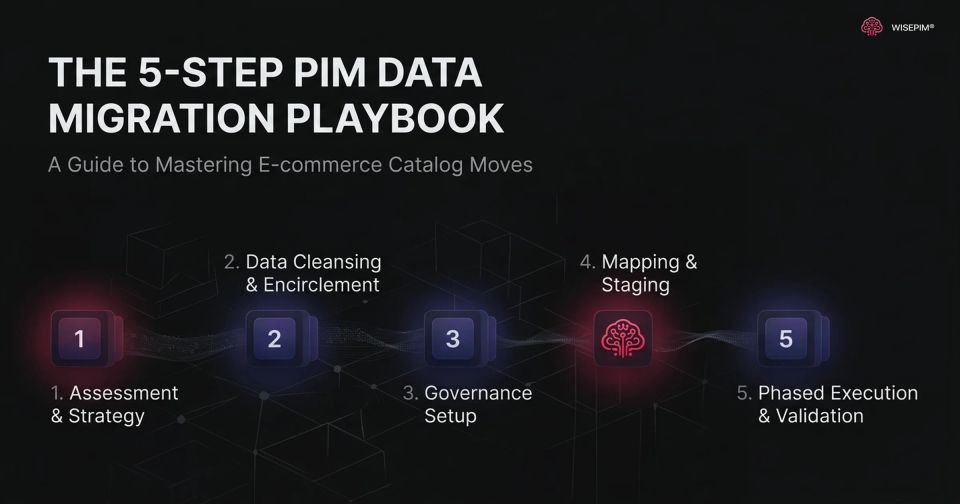
Data migrations often fail when organizations lack proper governance and staging environments. Moving a product catalog from legacy ERPs or scattered spreadsheets into a modern PIM is a high-wire act where one slipped mapping rule can detach thousands of high-resolution images from their parent SKUs.
A 500-SKU catalog with 40 attributes per product means 20,000 data points that someone has to keep accurate. Multiply that by multiple languages and sales channels, and the complexity scales exponentially. Inaccurate or incomplete product information costs sales, and every hour spent fixing data errors is an hour not spent on high-value work.
The stakes are incredibly high in 2026. In Akeneo's 2025 Consumer Returns Report, about 60 percent of shoppers said they had returned a product because of an inaccurate or misleading description. You cannot afford to botch your Catalog Migration. This guide breaks down exactly how to move your data without corrupting your catalog.
Why Lift-and-Shift is a Trap
Many companies try to save time by exactly replicating their old data model in the new platform. IT veterans know this is a mistake. Migration is the only good time to transform your taxonomy. If your old category structure was flawed, lifting and shifting just moves your problems to a more expensive piece of software.
Vendors often sell seamless, one-click migrations. The reality is that automated tools struggle with custom code, non-standard databases, and legacy workarounds. Manual data auditing and human-led mapping are almost always required. Legacy on-premise users are moving to the cloud rapidly, but moving dirty data into a cloud environment corrupts the new system from day one.
Skeptics rightly point out that enterprise platforms are not for everyone. For a small direct-to-consumer brand with fewer than 500 SKUs and a single Shopify storefront, the cost and complexity of migrating to a dedicated enterprise system often outweigh the benefits. A well-managed e-commerce backend is sometimes enough until the business scales. But for organizations managing thousands of SKUs across multiple borders, relying on legacy architecture is a liability.
The 5-Step Catalog Migration Process
Step 1: Establish Centralized Governance Before Touching the Data
Before moving a single cell of data, you need rules. Establish a dedicated data steward or governance team. Define strict data types so the new system does not immediately become a dumping ground.
Decide on date formats, currency symbols, and measurement units. If one legacy system used "cm" and another used "centimeters," you have to pick a standard. Implementing robust Data Governance ensures that your new architecture remains clean long after the initial transfer is complete.
Step 2: Cleanse and Normalize in a Staging Environment
Never migrate directly from the old system to the new platform. Data experts emphasize the absolute necessity of a staging area. You must extract the data, clean it in a staging environment, test the retrieval functions, and then push it to the live database.
Migrating through a staging environment
Migrating variations like "Blue", "blue", and "BLUE" creates duplicate filters on your front-end. Thorough Data Cleansing is a massive bottleneck, but it is mandatory. Cosmetics brand Abriga proved this when they migrated their catalog. By cleaning their data and automating their e-commerce syndication during the move, they reduced operational costs by PLN 100,000 per year.
Step 3: Map Complex Hierarchies and Digital Assets
Moving text is straightforward. Keeping high-resolution images, videos, and PDFs properly linked to their corresponding SKUs is where migrations fail. Moving complex product hierarchies from a flat Excel file into a relational database often breaks dependencies.
You need a rigorous Attribute Mapping strategy. Parent and child relationships, bundles, kits, and variants must be explicitly defined. If a parent product has a technical specification PDF, the migration logic must dictate whether the child variants inherit that document automatically.
Modern catalogs must account for contextualized experiences. Your database must hold a master record but format the output differently based on the destination. Amazon requires concise bullet points, direct-to-consumer sites need emotional storytelling, and B2B portals demand rigorous technical specifications. If your mapping strategy only accounts for a single output format, you will have to manually rewrite descriptions post-migration.
Step 4: Execute a Proof of Concept (PoC) Migration
Never execute a big bang migration. Moving your entire catalog at once makes it impossible to isolate mapping errors. Instead, start small.
Migrate a single product category or a specific sales channel first. This allows your team to test relationship mapping and refine the extraction process. Heavy equipment manufacturer Vermeer suffered from massive data silos, operating 150 different systems across their dealer network. By taking a phased approach to unifying their parts data, they allowed dealers to maintain autonomy while pulling from a single source of truth.
Manufacturing giant Assa Abloy also proved the value of a methodical approach when they migrated global product data. Their migration required managing complex, multilingual data at an enterprise scale. By treating the migration as a localization play rather than just a data transfer, they successfully improved data quality across multiple regions without breaking local compliance rules.
Step 5: Train the Merchandising Team on New Workflows
Practitioners often focus so heavily on the technical data transfer that they forget the human element. If you do not train the marketing and merchandising teams on the new workflows, you will experience immediate data degradation post-launch.
The new system will have different validation rules and approval states than your old spreadsheets. Your team needs to know how to create a new SKU without bypassing the mandatory attribute checks you just spent weeks building.
PIM migration readiness checklist
The Role of AI in Modern Migrations
The global Product Information Management market is growing, and much of this growth is driven by the shift toward AI-native hubs. Legacy platforms acted as passive filing cabinets. Today's AI-native tools actively participate in the migration.
We are seeing a decisive migration from fragmented spreadsheets toward unified platforms. Modern systems automatically identify inconsistencies, flag missing attributes, and spot look-alike products that belong together as variants during the migration process.
A well-executed Pim Migration turns complex data management into simple operations. Product content stops being an operational burden and becomes a competitive edge. Do the hard work in the staging environment, map your relationships carefully, and your e-commerce architecture will be ready to scale.