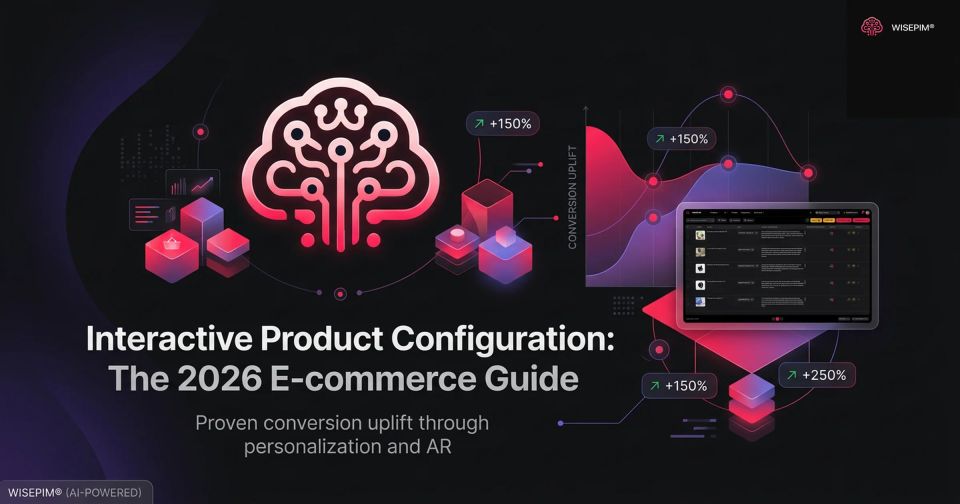
According to 2026 data from Kickflip, companies implementing interactive product personalization see an average conversion uplift of 150% compared to traditional static pages. When you add 3D rendering and augmented reality to the mix, that number can surge to 250%.
But building a customization engine that actually works requires more than just flashy front-end graphics. It demands a flawless data foundation.
At its core, product configuration is the process of allowing a buyer to customize a product's features, components, or aesthetics before purchasing. We have moved far beyond the basic drop-down menus of the early 2010s. Modern e-commerce relies on Configure, Price, Quote (CPQ) logic and visual composability to sell complex items directly to consumers.
Here is how the mechanics of product configuration actually function in 2026, where the pitfalls lie, and why your underlying data structure dictates your success.
The Anatomy of Modern Configuration
Static 2D image galleries are rapidly becoming obsolete for customizable goods. Buyers now expect to rotate a product 360 degrees, swap out materials in real-time, and project the finished item into their living room using a smartphone camera.
Take furniture brands like Palliser or Uttermost. Photographing every possible combination of a modular sectional—different armrests, 50 fabric choices, three leg finishes—is a logistical impossibility. Instead, they use composable 3D configurators. The user selects a specific product variant, and the software dynamically renders the exact combination on screen.
This shift is driving strong market growth, and analysts expect the CPQ software market to keep expanding over the next decade.
Analysts at Mordor Intelligence note a distinct pivot in how these tools are perceived. Configuration software has transitioned from a back-office utility for sales reps into a front-line revenue accelerator for the end consumer.
The Financial Impact of Visual Commerce
Putting the design process in the customer's hands changes their purchasing psychology. Interactive configurators keep shoppers on the page far longer than a static gallery. When users spend five minutes building their ideal sneaker or office chair, they develop a sense of ownership before they even reach the checkout screen.
Add-to-cart rates rise when customers can verify exactly what they are getting. Average Order Value (AOV) tends to climb as well, simply because premium upgrades, like leather upholstery instead of fabric, are visualized instantly.
Returns drop significantly as well. Threekit reports an average 5% reduction in return rates across the board. Specialized vendors like Zolak see up to a 60% reduction for highly configurable items like furniture and apparel. When a buyer can use augmented reality to confirm a custom sofa fits perfectly in their den, the likelihood of a costly return plummets.
The "Garbage In, Garbage Out" Trap
A visual configurator is a dumb terminal. It only knows what your backend systems tell it.
If your product data management is a mess of inconsistent attributes, duplicated SKUs, or missing dimensions, the configurator will fail. A user might successfully design a beautiful custom bicycle on your website, only to find out at checkout that the specific combination of a matte black frame and a 29-inch wheel is impossible to manufacture or out of stock.
Data governance is the single largest bottleneck in deployment. Companies frequently fall into the "perfect data delay" trap. They pause their configuration projects indefinitely while trying to clean up thousands of legacy SKUs in their ERP.
Experienced practitioners take a different route. They adopt a "crawl, walk, run" methodology. You launch the configurator with good-enough data on a single flagship product line. Once the logic is proven, you scale it across the rest of your product catalog.
Headless Architecture and the Composable Stack
Legacy configurators were monolithic black boxes. If a brand wanted to update a pricing rule or tweak a 3D model, they had to submit a support ticket to the vendor and wait three weeks.
That model is dead. In Gartner's 2025 Market Guide for Composable Product Configurators, analysts define the next wave of configuration strictly by "composability, intelligence, and connection."
Modern tools like Zakeke, Kickflip, and Logik.ai are API-first and headless. Cloud-based solutions now lead the market because they plug directly into your existing stack. They pull pricing from your ERP, rich media from your DAM, and structured attributes directly from your PIM.
For B2B manufacturers like Siemens or General Electric, this integration goes even deeper. Their web configurators automatically generate CAD files and Bills of Materials (BOM) for the factory floor. The exact specifications flow from the browser directly to the manufacturing queue without manual data entry.
Where a headless configurator gets its data
AI-Guided Selling vs. The Paradox of Choice
Handing a customer a blank canvas sounds empowering. In reality, it often triggers decision fatigue.
Giving a shopper 500 fabric choices for a customized jacket leads directly to cart abandonment. This is the classic paradox of choice. Successful catalog management requires curation.
AI is solving this by transforming passive configurators into active sales assistants. Instead of scrolling through endless menus, a customer can type, "Show me a modern, pet-friendly sofa under $2,000." The AI parses the structured product data, filters out velvet or delicate fabrics, and presents three highly relevant starting templates. The user tweaks the final details from a curated list of options, entirely bypassing choice paralysis.
Do You Actually Need 3D?
Vendors will push you toward high-fidelity 3D models and augmented reality for every item in your store. Resist this urge.
Creating photorealistic 3D assets is expensive and time-consuming. Heavy files can also drag down your page load speeds, killing conversions on mobile devices. If you are selling a basic t-shirt with three color variants and custom text printing, a lightweight 2D configurator is cheaper, faster, and equally effective.
Reserve the heavy 3D rendering for high-margin, complex products where visual validation is strictly necessary to close the sale.
Choosing between a 2D and a 3D configurator
Product configuration turns complex engineering and design options into a seamless, one-click experience for the buyer. But that front-end simplicity requires rigorous back-end organization. Before you invest in 3D models or AR functionality, ensure your product data is clean, structured, and ready to scale.