The Digital Services Act (DSA) is Regulation (EU) 2022/2065, the EU rulebook for intermediary services: internet access providers, hosting services, online platforms, online marketplaces and search engines. It has applied to all of them since 17 February 2024. Very large online platforms with 45 million or more monthly users in the EU, such as Amazon Store, AliExpress and Zalando, had to comply earlier, four months after the Commission designated them. For online marketplaces, three articles matter most: Article 30 (verify every trader before they can sell), Article 31 (let traders publish complete product and safety information) and Article 32 (tell buyers when they bought an illegal product).
If you sell on a marketplace, the DSA reaches you through the platform. Before you can list, the marketplace has to collect and check your company details, show some of them to buyers, and give you fields for product identification and safety labeling that you are expected to fill. Your own webshop selling your own stock is not an intermediary service, so the marketplace chapter does not apply to it directly. This article explains the obligations in plain terms; it is not legal advice, so check your situation with a lawyer or your marketplace's seller help.
Who the Digital Services Act applies to, layer by layer
The DSA stacks its obligations. Every intermediary service carries the basic duties, hosting services add a few, online platforms add more, marketplaces add the trader rules, and the very largest platforms carry the heaviest load. Each layer includes the ones above it in the table.
DSA obligations by type of service
| All intermediary services | Internet access, caching, hosting | Points of contact, terms and conditions, transparency reports | 11 to 15 |
|---|---|---|---|
| Hosting services | Cloud storage, web hosting | Notice and action, statement of reasons | 16 to 18 |
| Online platforms | Social networks, app stores, marketplaces | Complaint handling, no dark patterns, ad labels, recommender transparency | 19 to 28 |
| Online marketplaces | Platforms where consumers buy from traders | Trader traceability, compliance by design, right to information | 29 to 32 |
| Very large platforms and search engines | 45 million or more monthly EU users | Systemic risk assessment and mitigation, audits, a non-profiling recommender option | 33 to 43 |
Two carve-outs matter for smaller players. Article 19 exempts online platforms that are micro or small enterprises (under the EU definition in Recommendation 2003/361/EC) from most platform duties, and Article 29 does the same for the marketplace section, unless the platform has been designated as very large. A niche marketplace run by a small team can therefore be outside Articles 30 to 32 even though it hosts third-party sellers. Articles 30 to 32 are also written for platforms "allowing consumers to conclude distance contracts with traders". On a plain reading of that wording, a B2B marketplace that sells only to business buyers falls outside them, while the general platform rules still apply. A product review section on a webshop stores user content, but under the definition in Article 3(i) it is not an online platform when it is a minor and purely ancillary feature of the main service.
DSA dates from adoption to the first marketplace fines
Digital Services Act milestones for e-commerce
19 October 2022
Regulation (EU) 2022/2065 adopted
Published in the Official Journal on 27 October 2022 (OJ L 277).
16 November 2022
Entry into force
Twenty days after publication. The rules on publishing user numbers and on designating very large platforms apply from this date.
25 April 2023
First very large platforms designated
17 platforms and 2 search engines, including AliExpress, Amazon Store, Booking.com, Google Shopping and Zalando. They had four months to comply.
17 February 2024
The DSA applies to all intermediaries
Marketplaces must verify new traders before letting them sell. Member States had to name their Digital Services Coordinators.
17 February 2025
Deadline for existing traders
Marketplaces had 12 months to collect the Article 30 details from traders already selling on 17 February 2024, and must suspend traders who did not provide them.
28 May 2026
Temu fined EUR 200 million
For failing to assess the systemic risk of illegal products on its platform.
20 July 2026
AliExpress fined EUR 550 million
For failing to assess and mitigate the risk of illegal, unsafe and counterfeit products.
The designation press release of 25 April 2023 lists the first group of very large platforms. For the EU product rules that land next to the DSA, such as the General Product Safety Regulation, the packaging rules and the EUDR, the EU product compliance tracker and the compliance calendar keep the dates in one place.
Article 30: the trader details a marketplace collects before you can sell
Article 30 is the know-your-business-customer rule. A marketplace that lets consumers buy from traders may only let you offer products to consumers in the EU once it has obtained, where applicable to you:
- Name, address, telephone number and email address of the trader.
- A copy of an identification document or an electronic identification under the eIDAS Regulation.
- Payment account details.
- Trade register and registration number, if you are registered in a trade register or similar public register.
- A self-certification in which you commit to offer only products that comply with EU law.
The marketplace then has to make best efforts to check that this information is reliable and complete, using official databases or asking you for supporting documents. You remain liable for its accuracy. If the platform later has reason to believe a detail is wrong, incomplete or out of date, it asks you to fix it, and if you do not, it must suspend your offers to EU consumers until you do. It keeps the data for six months after your contract ends and then deletes it.
Three of the five items are public: the marketplace must show your name, address, telephone number and email, your trade register details and your self-certification on the platform, at least where your product information appears. Use a monitored customer service address and phone number, not a director's personal mobile. If the platform refuses or suspends you under this article, you can lodge a complaint through its internal complaint system (Article 20) and go to a certified out-of-court dispute settlement body (Article 21).
Article 31: compliance by design and the product fields behind it
Article 31 puts the burden on the marketplace's interface. It must be designed so that traders can meet their pre-contractual, compliance and product safety information duties under EU law. In particular, it must let you provide the name, address, telephone number and email of the economic operator responsible for the product, and at least:
- Information that identifies the product clearly and unambiguously.
- Any sign identifying the trader, such as a trademark, symbol or logo.
- Labeling and marking information required by EU product safety and product compliance law, where it applies.
Before letting you sell, the marketplace must make best efforts to check that you supplied this information, and afterwards it must make reasonable efforts to randomly check official, machine-readable databases for products identified as illegal. In practice this is why marketplace listing forms now carry required fields for the manufacturer, the EU responsible person and safety warnings, and why listings with empty ones get blocked or hidden.
The DSA only obliges the marketplace to offer the fields. The duty to fill them comes from product law, mainly Article 19 of the General Product Safety Regulation (EU) 2023/988, which has applied since 13 December 2024. It requires every online offer to show the manufacturer's name and postal and electronic address, the EU responsible person if the manufacturer is outside the EU, information that identifies the product (including a picture, its type and any other identifier) and any warnings or safety information in a language consumers in that country understand. Our GPSR guide covers that side in detail.
From DSA and GPSR requirement to product data field
| Manufacturer name and contact | GPSR Art. 19(a), DSA Art. 31(1) | manufacturer_name, manufacturer_address, manufacturer_email | Brand name, street, postcode, city, country, support email |
|---|---|---|---|
| EU responsible person | GPSR Art. 19(b) | eu_responsible_person, eu_rp_address, eu_rp_email | Only when the manufacturer is outside the EU |
| Product identification | GPSR Art. 19(c), DSA Art. 31(2)(a) | gtin, mpn, model or type, main image | GTIN 9506000134352 (GS1 demonstration number) |
| Trademark or logo | DSA Art. 31(2)(b) | brand | The registered brand name |
| Warnings and safety information | GPSR Art. 19(d) | safety_warnings per language | Not suitable for children under 36 months, in the buyer's language |
| Labeling and marking | DSA Art. 31(2)(c) | ce_marking, certifications, label images | CE, plus the standard the product was tested against |
| Correct category | Marketplace compliance checks | category per channel | The category whose rules really apply to the product |
Field names differ per marketplace, which is why the same manufacturer address ends up typed into four seller portals. The marketplace listing requirements report and the per-platform marketplace listing guides show what each channel asks for.
Article 32: when buyers must be told they bought an illegal product
If a marketplace becomes aware, by any means, that a trader sold an illegal product or service to consumers in the EU, it must inform the buyers it has contact details for. It tells them that the product is illegal, who the trader is and which means of redress they have. The duty covers purchases in the six months before the platform became aware. Where it lacks contact details for all buyers, it must publish the information on its interface.
For a seller this has two consequences. Your identity goes to every affected buyer, and you need to answer quickly which units you sold, where and when. That is easier when every listing is tied to a stable SKU and GTIN, and when you can show the batch or version and the safety documents behind each one.
Notices, removed listings and how sellers can appeal
Every hosting service, and so every marketplace, must run a notice and action mechanism (Article 16). Anyone can report a listing they consider illegal, including a brand owner who spots a counterfeit or a competitor who spots a missing CE marking. A notice must explain why the content is illegal, give its exact location (such as the URL) and include a statement of good faith.
- Statement of reasons (Article 17): if the platform removes, hides or demotes your listing, stops payments or suspends your account, it must tell you why, on which legal or contractual ground, whether automated means were used and how you can seek redress.
- Internal complaint (Article 20): you can complain electronically and free of charge for at least six months after the decision.
- Out-of-court settlement (Article 21): you can take the dispute to a certified body instead of a court.
- Repeat offenders (Article 23): platforms must suspend, after a warning, users who frequently provide manifestly illegal content, and must describe that policy in their terms.
When a listing disappears, read the statement of reasons before you edit anything. If the reason is a data gap, such as a missing warning or a wrong category, fix the product record at the source so the same gap does not reappear on the next marketplace.
Recommender systems, ad labels and the dark pattern ban
Several platform rules shape how your products are shown rather than what you must supply. Article 27 requires platforms to explain in their terms the main parameters of their recommender systems, which includes the ranking of search results, and the reasons for their relative importance. Very large platforms must also offer at least one recommender option that is not based on profiling (Article 38). Article 26 requires every ad to be labeled, with the name of whoever it is presented for and who paid for it, so sponsored product placements show your company name. Article 25 bans interfaces that deceive or manipulate users, except for practices already covered by the Unfair Commercial Practices Directive or the GDPR.
The useful part for sellers is Article 27: each marketplace now publishes what drives its ranking. Read those parameters for your main channels; they often name relevance signals that come straight from product data, such as titles, attributes and category.
What the Temu and AliExpress decisions say about product data
The first marketplace decisions targeted the obligations of very large platforms, not individual sellers, but they show what regulators test. On 28 May 2026 the Commission fined Temu EUR 200 million because its risk assessment relied on general e-commerce information instead of evidence about its own service. A mystery shopping exercise found that a very high percentage of selected chargers failed basic safety tests and a high percentage of tested baby toys posed medium to high safety risks. Temu had until 28 August 2026 to submit an action plan.
On 20 July 2026 the Commission fined AliExpress EUR 550 million. One finding is a pure product data problem: its compliance checks could be circumvented through mis-categorisation, because traders put products in the wrong category to face more flexible requirements. The Commission also found the brand authorisation system against counterfeits understaffed and its penalty policy for traders not properly enforced. AliExpress was given until 20 October 2026 to submit an action plan. Commission fines on very large platforms are capped at 6% of total worldwide annual turnover (Article 74); for all other providers, Article 52(3) requires Member States to set the same 6% maximum in national law.
DSA checklist for marketplace sellers
Before your next marketplace review
Keeping marketplace identification and safety fields complete in one place
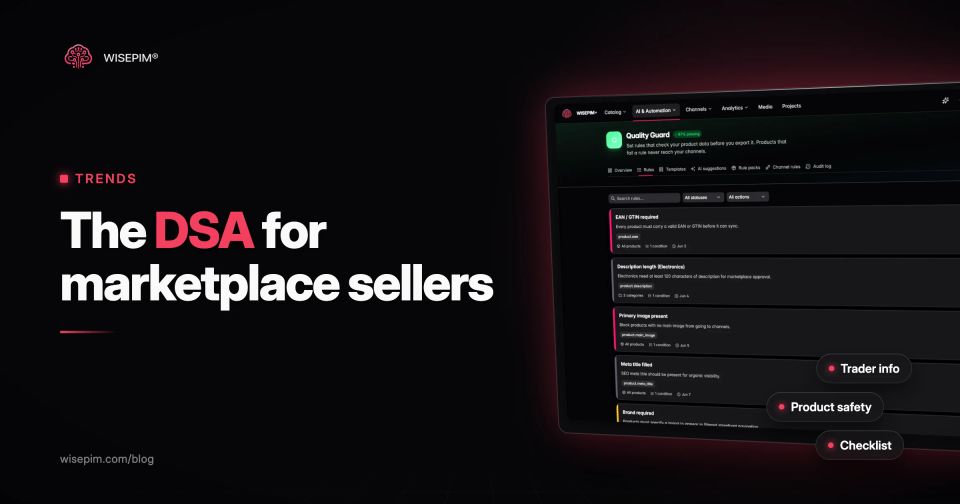
WISEPIM is a PIM, not a marketplace, and it has no DSA feature: trader verification happens between you and each platform. What it can do is hold the product side of the checklist once. Manufacturer details, the EU responsible person, warnings and certifications can live as attributes next to the GTIN, MPN and brand, and Quality Guard rules can warn about, skip or block a product whose required fields are empty before it is exported to a channel.
Keep the legal judgment with people: an AI can translate a warning or suggest a category, but someone who knows the product should confirm that the warning and the category are right before they go live.