E-commerce teams, we need to address the pervasive question: Is Google going to penalize AI-generated content, specifically those new product descriptions you are creating?
There are conflicting opinions. Some believe Google dislikes AI content intensely. Others assert their AI tools are undetectable. The reality lies somewhere in between, and it hinges more on quality than source.
Let's explore this.
The "Mueller Misunderstanding" and the Great AI Panic of '23
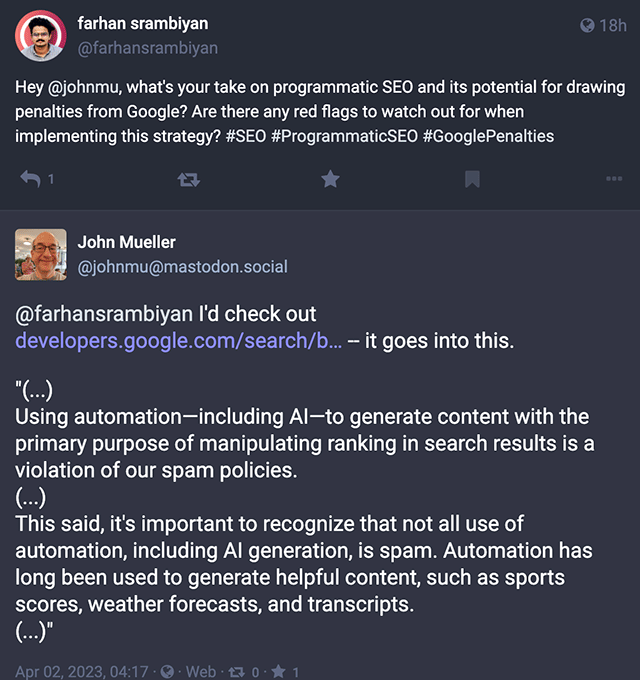
Recall when Google's John Mueller commented on AI-generated content back in the day? The SEO community collectively experienced a moment of shock. Mueller essentially stated that AI-generated content could be classified as "automatically generated content," something Google has historically discouraged.
Here is the quote that initiated the concern:
This sparked widespread concern. People envisioned their websites dropping in search rankings.
But let's dissect this:
Point 1: "Automatically Generated" Doesn't Always Mean Evil
Google's guidelines have always cautioned against "spammy automatically-generated content." Remember those nonsensical, keyword-stuffed articles from years ago? They offered minimal value.
The issue isn't that a machine generated the content; it's that it was poor quality. Google prioritizes user experience. If your content is subpar, both Google and your customers will take notice.
Point 2: AI Has Evolved (Thank Goodness!)
Mueller's remarks about "shuffling words" and "looking up synonyms" referred to older AI content methods. We're not discussing outdated translation software.
Modern AI, particularly that utilized in solutions like WISEPIM, is capable of producing remarkably refined, natural-sounding content. It's a substantial advancement.

Google's Real Obsession = YOU (and Your Customers)
The crucial point is: Google prioritizes users. Their business model depends on delivering relevant, useful search results.
Consider this: If Google consistently provided irrelevant results, users would quickly switch to alternative search engines.
Google's "Helpful Content" update emphasized this. They prioritize content that is:
- Original: Not simply reworded from other sources.
- Helpful: Genuinely answers user queries or resolves their issues.
- Created for people: Written in an engaging, understandable manner.
Note the absence of "Written by a human."
Quality Over Origin: The E-E-A-T Framework
Google's December 2022 update brought the E-E-A-T framework:
Experience, Expertise, Authoritativeness, and Trustworthiness. This is the core factor in content ranking.
Let's apply this to PIM and e-commerce:
- Experience: Does your product description demonstrate an understanding of the product and its applications? For instance, instead of only listing features of pajamas, describe the user experience: "Feel the comfort of these soft, ethically-sourced cotton pajamas after a demanding day..."
- Expertise: Do you exhibit knowledge of the product category? Are you employing the correct terminology? If selling premium hiking boots, refer to them accurately, not simply as "shoes."
- Authoritativeness: Are you a reliable information source? Customer reviews, product certifications, and precise data contribute to this.
- Trustworthiness: Is your product information truthful and current? Are you transparent regarding pricing, shipping, and returns? Avoid resembling a dubious salesperson.
If your AI-generated product descriptions excel in E-E-A-T, Google is more inclined to reward you with improved rankings.
Can Google Actually Detect AI Content? (The Magic Trick Analogy)
This is where it becomes nuanced. Yes, theoretically, Google could detect AI-generated content. They possess some of the world's most sophisticated machine learning models.
However, companies developing AI content generators also have access to these models. It resembles a continuous back-and-forth, perhaps best illustrated as a contest between magicians.
Consider two magicians. One uses a basic, readily available magic kit. The second, having mastered fundamentals, incorporates unique elements and techniques. The first magician's tricks are foreseeable. The second magician is far more challenging to decipher.
This parallels AI content generation. Using a rudimentary, "off-the-shelf" AI model might yield recognizable patterns. But solutions like WISEPIM employ proprietary methods, integrating our unique enhancements. This renders the output significantly harder to identify as AI-generated. It's not about deceiving Google; it's about crafting superior, more distinctive content.
The WISEPIM Advantage: AI That Doesn't Suck
So, will Google penalize AI content? The response is: It is contingent. Low-quality, spammy AI content? Certainly. High-quality, helpful, E-E-A-T-focused AI content that improves the user experience? Unlikely.
This is WISEPIM's strength. We are not merely assembling keywords haphazardly. We are leveraging AI to:
- Enrich Product Data: Supplementing missing information, rectifying errors, and guaranteeing consistency across all channels.
- Generate High-Converting Descriptions: Developing engaging narratives that resonate with customer needs and aspirations.
- Translate and Localize: Expanding product accessibility to a global market.
- Optimize for Search: Utilizing pertinent keywords and semantic variations to enhance visibility.
We're taking the "automatically generated" aspect and infusing substantial human expertise to create product information that drives sales.
The Bottom Line (and a Call to Action That's Not Too Pushy)
Concentrate on the quality of your content, not solely on whether it's "AI-generated." Deliver value, offer assistance, and employ the optimal tools to create exceptional product experiences.
If you seek a PIM solution that harnesses AI's power while maintaining quality, you know where to reach us.
Interested in how WISEPIM can revolutionize your product information? Book a demo – we assure you it will not be a monotonous sales presentation. We may even include a joke or two. (No guarantees regarding the humor quality, though.)