Psychological pricing is setting and presenting prices so that shoppers perceive them the way you intend, not only as a number. The best known tactics are charm pricing (EUR 19.99 instead of EUR 20), prestige pricing (a round EUR 200 for a premium item), anchoring with a higher reference price, decoy pricing with a third option that makes another look better, bundle pricing and price framing (per unit, per month, per use).
These tactics work on perception, so they sit close to the line between persuasion and misleading the customer. In the EU that line is written down: the Omnibus prior-price rule decides what a crossed-out "was" price must be, and the Unfair Commercial Practices Directive covers inflated reference prices and drip pricing. This guide explains each tactic, what the research actually shows, a worked example for each, the legal checks, and how to apply price endings per sales channel without editing every price by hand.
Charm pricing and the left-digit effect
Charm pricing ends a price just below a round number: 9.99, 19.95, 249. The mechanism researchers point to is the left-digit effect: people read a price from left to right and anchor on the first digit, so 2.99 registers closer to 2 than to 3. In five experiments published in the Journal of Consumer Research, Thomas and Morwitz found that a price ending in 9 is judged lower than one a cent higher only when the leftmost digit changes, as in 2.99 versus 3.00, and the effect was stronger when the compared prices were close together.
Field evidence points the same way. In three field experiments with a mail-order retailer, Anderson and Simester found that a $9 price ending increased demand in all three tests. The increase was stronger for new items than for items the retailer had sold in earlier years, and there was some evidence that 9-endings work less well when the price already carries a "Sale" cue. The authors read this as a signal that 9-endings matter most when customers have little other information about the price.
Which prices to charm and which to leave alone
The left-digit finding gives you a practical filter. Moving from 25.00 to 24.99 changes the first digit a shopper reads. Moving from 24.60 to 24.59 changes nothing a shopper anchors on, so the research gives no reason to expect a lift, and you give away a cent per sale. Charm endings earn their place where they cross a digit boundary:
- Cross a tens or hundreds boundary: 100 to 99, 1,000 to 999. These are the cases the studies describe.
- New and unfamiliar products: shoppers have no reference price yet, which matches the conditions in the Anderson and Simester experiments.
- Skip it on items already marked as on sale: the sale badge carries the price message, and the evidence for an extra effect there is weaker.
- Pick one ending per store and stay consistent: .99 and .95 are both common in euro webshops. No study we found compares their effect directly, so choose the one that fits your brand and apply it everywhere.
Prestige pricing: when a round number fits better
Round prices are the deliberate opposite of charm prices. A EUR 200 watch strap or a EUR 50 gift box signals that the buyer is not meant to compare cents. Research by Wadhwa and Zhang in the Journal of Consumer Research found that rounded prices such as 200.00 are processed more fluently and encourage people to rely on feelings, while non-rounded prices such as 198.76 encourage them to rely on reasoning. When the price format matched how the decision was being made, the choice "felt right", and that made people's reactions to the product stronger in either direction: a positive view became more positive.
In catalog terms that suggests a rough split, not a rule the study tested. Gifts, fragrance, jewelry, experiences and hobby items often suit round prices. Replacement parts, consumables, tools and anything bought against a spec sheet suit precise prices. B2B price lists sit on the reasoning side: the buyer is calculating, not browsing.
Anchoring with a reference price
An anchor is the first price a shopper sees, and it shapes how every later price is judged. On a product page the anchor is usually one of these:
- A crossed-out price, presented as the earlier price of the same item.
- A recommended retail price (RRP or [MSRP](https://wisepim.com/blog/msrp)) from the manufacturer, shown as a comparison.
- A premium model shown first in a range, so the mid-range model looks reasonable.
- The price of a bigger pack or a full set, shown next to the single item.
Anchors are where most legal risk sits, because a reference price that was never charged, or an RRP nobody sells at, creates a price advantage that does not exist. The EU rules for both are covered further down. The data rule is simple: if you show a reference price, it has to be a stored, dated, verifiable value in your catalog, not a number typed into a template.
Decoy pricing with three options
A decoy is an option few people are meant to buy. Its job is to make another option look clearly better. Huber, Payne and Puto showed in 1982 that adding an alternative that is dominated by one option, but not by the other, can increase the chance that people choose the option that dominates it. Marketers call this the decoy effect.
Here is an illustrative example with coffee beans. The 750 g bag costs the same as the 1 kg bag, so the 1 kg bag beats it on every count, while the 250 g bag does not (it is cheaper). That is the asymmetric setup Huber and colleagues tested, and its purpose is to make the 1 kg bag look like the obvious deal:
- 250 g bag: EUR 8.95 (EUR 35.80 per kg)
- 750 g bag (the decoy): EUR 24.95 (EUR 33.27 per kg)
- 1 kg bag: EUR 24.95 (EUR 24.95 per kg)
Two things make this work in a webshop. The three sizes need to sit side by side, as variants of one product or in one comparison block, and the price per kilogram has to be correct. The EU Price Indication Directive already requires a unit price for most goods sold by weight or volume, as the European Commission's guidance notes, so the net content of every variant needs to be stored as a number with a unit, not buried in the title.
Bundle pricing and multi-buy offers
A bundle sells several items for one price that is lower than the sum of the parts: a shampoo and conditioner set, a camera with a spare battery, a starter kit. Bundles lift the order value and make price comparison harder, which is why marketplaces and price comparison sites treat them as separate products. Give each bundle its own SKU, title, component list and image, and keep the component prices stored so you can show the saving honestly (see product bundles for the main bundle types).
Multi-buy offers such as "buy two, get the third free" or "30% off when you buy three" are a related tactic. The Commission treats them as tied or conditional offers: they fall outside the prior-price rule but remain fully subject to the Unfair Commercial Practices Directive, so the saving must be real.
Price framing: per unit, per month, from
The same price can be framed in ways that change how large it feels. A EUR 36 annual refill subscription reads as EUR 3 a month. A EUR 4.95 bottle of 500 ml cleaner reads as EUR 9.90 per liter, which helps against a cheaper-looking 250 ml bottle. A "save EUR 10" message and a "20% off" message describe the same discount on a EUR 50 item.
Two framing tactics are restricted. "From" prices are not banned, but the advertised entry price has to be available in reasonable quantities, and the guidance cites a national court that accepted an entry-level price on its own only where the final price could not reasonably be calculated in advance, as with a made-to-measure blind. And the first price shown must be the total price, including taxes and unavoidable charges, which rules out drip pricing. Both points come from the Commission's guidance on the Unfair Commercial Practices Directive, covered next.
EU price rules: Omnibus prior prices and misleading reference prices
Two sets of EU rules limit psychological pricing for consumer sales. National enforcement differs between member states, so treat this as orientation and check your own country's rules or ask a lawyer before a big campaign.
Article 6a: the lowest price in the last 30 days
The Omnibus Directive added Article 6a to the Price Indication Directive. Any announcement of a price reduction must show the prior price, defined as the lowest price the trader applied in at least the 30 days before the reduction. The Commission's guidance on Article 6a spells out what that means in practice:
- Earlier promotions count. If the item was discounted two weeks ago, that discounted price is the prior price for the next reduction.
- Successive campaigns do not reset the clock. The guidance names Black Friday, Cyber Monday and Christmas sales in November and December: each new reduction refers to the lowest price in the previous 30 days, including the earlier sale price. Our Black Friday checklist covers the rest of the campaign preparation.
- It applies per sales channel. If you sell at different prices in different shops, the prior price in each channel is the lowest price you applied in that channel.
- Some practices fall outside it. Long-running loyalty discounts, genuinely personalized vouchers, comparisons with other traders or an RRP, and multi-buy offers are not price reductions under Article 6a, but the Unfair Commercial Practices Directive still applies.
- Member states have options for perishable goods, products on the market for less than 30 days and progressive reductions within one continuous campaign.
Crossed-out RRPs and fake "was" prices
The Commission's guidance on the Unfair Commercial Practices Directive says a trader comparing with a recommended retail price must make clear, right next to it, that it is a comparison and not an earlier price of its own. That matters most for crossed-out prices, which shoppers read as a reduction. An RRP that is unreasonably high or unrealistic can be misleading in itself. The guidance cites national cases where a trader compared against an importer's RRP that did not match what retailers actually charged, and where crossed-out furniture prices had never been charged at all.
Drip pricing and the total price
The same guidance describes drip pricing as adding unavoidable charges during checkout that should have been in the price from the start. The price in the first invitation to purchase has to include VAT and every charge that is unavoidable and foreseeable when the offer is published. A low headline price with a compulsory "service fee" added at checkout is the textbook case.
Psychological pricing tactics and the EU rule that applies
| Charm pricing | EUR 24.99 | None specific | Inconsistent endings across channels |
|---|---|---|---|
| Prestige pricing | EUR 200 | None specific | Round prices on items bought by spec |
| Crossed-out earlier price | EUR 39.99, now EUR 29.99 | Price Indication Directive Art. 6a | Prior price is not the 30-day low |
| RRP comparison | RRP EUR 49.99 | UCPD Art. 6(1)(d) | RRP nobody charges, read as a reduction |
| Decoy pricing | 250 g, 750 g, 1 kg | Unit price indication | Wrong or missing price per kg |
| Multi-buy offer | 3 for 2 | UCPD (tied offers) | Saving smaller than claimed |
| From price | From EUR 79 | UCPD Art. 7(4)(c) | Entry price not really available |
| Headline price plus fees | EUR 19 + service fee | UCPD (drip pricing) | First price is not the total |
Price endings per channel, set once at export
Psychological pricing breaks down in multichannel catalogs. The webshop wants .99 endings, the marketplace price has to absorb a commission, the B2B price list should show round net prices, and nobody wants to maintain four price columns per product. The cleaner pattern is to keep one stored base price and cost price per product and derive each channel's price with rules, including the rounding.
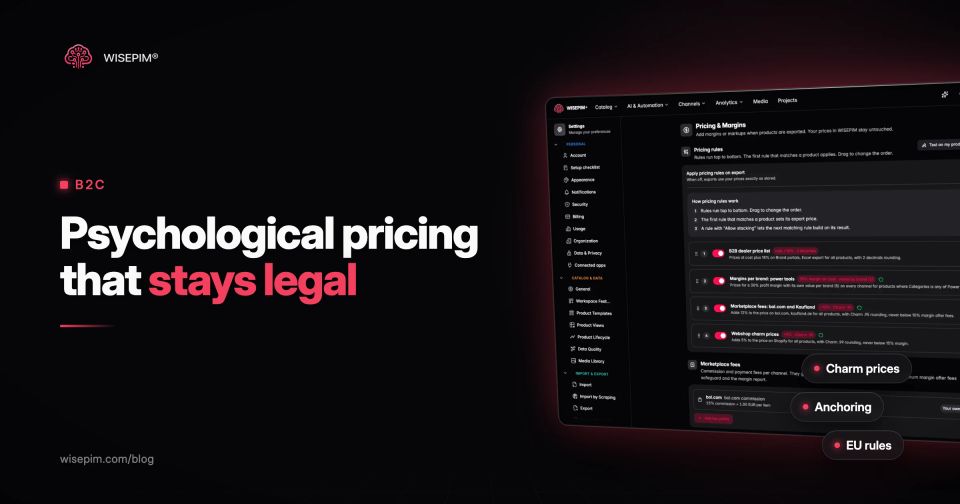
That is how channel pricing works in WISEPIM. Pricing rules run at export, per channel (a platform, one shop, CSV or Excel exports, or feeds), and never change the stored price. A rule calculates a percent markup, a fixed amount, cost plus markup, cost plus margin or a fixed price, and then rounds: none, two decimals, whole numbers, charm .99 or charm .95. Safeguards set a minimum and maximum price, a minimum margin percentage and a maximum deviation from the base price. If a charm ending would land below the margin floor, the price moves up to the next charm point: the safeguard wins over the pretty price.
Take an illustrative pour-over coffee dripper with a stored price of EUR 24.10 and a cost price of EUR 13.20. Charm rounding goes to the next charm point, so EUR 25.31 becomes EUR 25.99, and an exact EUR 26.00 would become EUR 25.99:
One stored price, four channel prices
| Webshop | +5% | 25.31 | Charm .99 | 25.99 | 49% |
|---|---|---|---|---|---|
| Marketplace | +12% | 26.99 | Charm .95 | 26.95 | 51% |
| B2B price list (Excel) | Cost +18% markup | 15.58 | Whole | 16.00 | 17.5% |
| Shopping feed | No rule | 24.10 | None | 24.10 | 45% |
The marketplace row shows a detail worth knowing: charm .95 can land slightly below the calculated price (26.99 becomes 26.95), because it takes 5 cents off the next whole number. If you want to check what a markup does to your margin before writing a rule, the markup calculator runs the sums, and our guide to markup vs margin explains why an 18% markup is not an 18% margin.
Because the exported price differs per channel, the Article 6a point about channels applies directly: when you announce a reduction, the prior price for each channel is the lowest price you exported to that channel in the previous 30 days. A rule change that lowered a channel price for a week counts toward that low.
Checks before you change price endings or run a promotion
Testing pricing tactics on your own catalog
The studies above describe tendencies under specific conditions, not a guaranteed lift for your store. Test a tactic on one category or one channel at a time, keep everything else equal, and compare conversion rate and margin over the same weeks. WISEPIM is not an A/B testing tool and does not split traffic: it keeps the price logic consistent per channel, so that when you decide on an ending or a markup, the change reaches every product and channel in one place. If you also sell under a manufacturer's pricing policy, read our guide to MAP pricing policies before you set endings that go below an advertised floor.