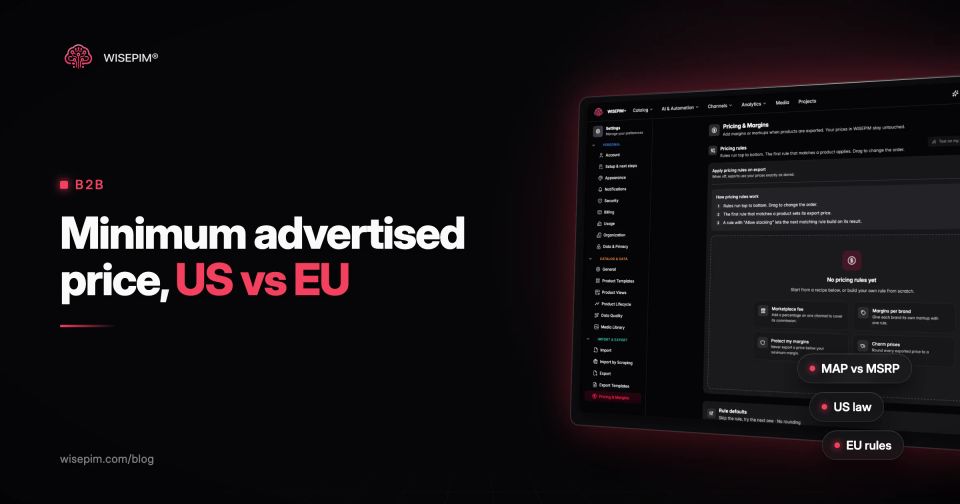
A minimum advertised price (MAP) is the lowest price a brand allows its resellers to show in advertising: on a product page, in a Google Shopping ad, in a marketplace listing, in a newsletter. A MAP policy limits the advertised price, not the selling price. A reseller can still sell below MAP at the register, in the cart or over the phone, as long as it does not publish that lower price.
Whether a brand can use MAP depends on where it sells. In the United States, a unilateral MAP policy is a common and generally lawful tool under federal law, with stricter rules in some states. In the European Union, the Commission's 2022 guidelines treat MAP as an indirect form of resale price maintenance, a hardcore restriction, so the safe options there are recommended and maximum prices. This post explains both systems and the practical side of monitoring. It is general information, not legal advice: have a competition lawyer review any pricing policy before you send it to resellers.
MAP, MSRP and resale price maintenance side by side
Three terms get mixed up in dealer contracts and marketplace forums. The MSRP (manufacturer's suggested retail price, also called RRP in Europe) is a recommendation the reseller is free to ignore. Resale price maintenance (RPM) is any agreement that fixes the price a reseller charges, or sets a floor below which it may not sell. MAP sits in between: it leaves the transaction price free and controls only what the reseller advertises.
MSRP, MAP and minimum resale prices compared
| MSRP / recommended price | Nothing binding; a suggested price | Yes | Lawful | Allowed, unless pressure or incentives turn it into a floor |
|---|---|---|---|---|
| Maximum resale price | A price ceiling | Yes | Rule of reason | Allowed, same condition |
| Minimum advertised price | The lowest price shown in ads and listings | Yes, if not advertised | Generally lawful when unilateral | Treated as indirect RPM (guidelines, paragraph 189) |
| Minimum or fixed resale price | The actual selling price | No | Rule of reason since 2007; per se illegal in some states | Hardcore restriction |
Reasons brands set a minimum advertised price
Brands rarely introduce MAP because they want higher prices for their own sake. The usual motives come from the reseller network:
- Keeping service-heavy dealers in the network. A specialist shop that demonstrates a product, gives advice and handles returns loses sales when a shopper compares its price with a discounter's ad. The EU guidelines describe the same free-riding problem for complex products.
- Stopping loss leaders. One reseller advertising a known product below the wholesale price can damage the brand's image and push other resellers to drop it.
- Slowing automatic price spirals. Many large webshops use repricing software that follows the lowest competitor, which the Commission noted in its 2018 decisions. One low advertised price can then spread across a whole channel.
- Protecting a launch. New products often get a stable advertised price for the first months so resellers are willing to stock and promote them.
Each of these goals can also be reached in other ways, such as selective distribution, service requirements or recommended prices. In the EU those alternatives are usually the only safe route.
What a MAP policy covers and what it leaves to the reseller
A MAP policy stands or falls on its definition of "advertised". Most brand policies cover every place a shopper can see a price before deciding to buy:
- Webshop product and category pages, including the price shown in on-site search results.
- Shopping ads and comparison sites, such as Google Shopping, where the feed price is the advertised price.
- Marketplace listings on Amazon, eBay or Walmart, because the listing price is visible to every visitor.
- Email, social posts and printed flyers that name a price.
- Coupon codes and "buy one, get one" offers that a policy may count as advertising a lower effective price. Spell out whether they do.
What a MAP policy usually leaves alone: the price a shopper sees after adding the item to the cart, a quote given by phone or email to one customer, and in-store prices that are not promoted. Some resellers respond to MAP with "add to cart to see price". Decide in the policy whether that counts, and check the channel rules too: Google Merchant Center expects the feed price to match the landing page, which our guide on the mismatched price error covers.
US law on MAP: Colgate, Leegin and the states that differ
US practice rests on two Supreme Court cases. In United States v. Colgate & Co. (1919) the Court held that a manufacturer can announce resale prices in advance and refuse to deal with resellers who do not follow them. The key word is unilateral: the brand announces a policy and acts on it alone, without asking resellers to agree.
In Leegin Creative Leather Products v. PSKS (decided 28 June 2007), the Court overruled the 1911 Dr. Miles decision and held that vertical price restraints are judged under the rule of reason. Courts now weigh the pro-competitive effects of a minimum price arrangement against the harm, instead of condemning it automatically. The FTC's guidance on manufacturer-imposed requirements adds the caveat that matters for national brands: some state antitrust laws and international authorities still view minimum price rules as illegal per se.
For a brand selling nationally, that caveat is practical: a policy that passes federal review can still fail under the law of a state where your resellers operate, so have counsel check the states that matter to your distribution before you roll it out.
Advertising restrictions have their own limits too. The FTC page describes its challenge to the MAP policies of five large distributors of pre-recorded music. Those policies barred discounted prices even in ads the retailer paid for itself, also covered in-store advertising, and a single violation could cost a retailer funding for all of its stores for up to 90 days. Because they were in effect for more than 85 percent of market sales, the FTC found them unreasonable.
Key decisions behind MAP and minimum resale prices
1911
Dr. Miles
The Supreme Court treats minimum resale price agreements as illegal per se.
1919
Colgate
A manufacturer may announce resale prices and refuse to deal with resellers who ignore them.
28 June 2007
Leegin
Dr. Miles is overruled; vertical price restraints fall under the rule of reason in federal law.
24 July 2018
EU fines four electronics brands
The Commission fines Asus, Denon & Marantz, Philips and Pioneer over EUR 111 million for resale price maintenance online.
1 June 2022
EU Regulation 2022/720 applies
The new vertical block exemption and guidelines name MAP as an indirect means of RPM.
Why the EU treats minimum advertised prices as resale price maintenance
In the EU, vertical agreements between suppliers and resellers are assessed under Article 101 of the Treaty, with Regulation (EU) 2022/720 as the safe harbor. Article 4(a) lists the restriction of a buyer's ability to set its own sale price as a hardcore restriction. The same article allows a supplier to impose a maximum price or recommend a price, provided pressure or incentives do not turn either into a fixed or minimum price.
The Commission's Guidelines on vertical restraints leave little room for MAP. Paragraph 187 lists imposing minimum advertised prices among the indirect means of RPM, next to fixing the reseller's margin and threatening to delay deliveries. Paragraph 189 explains why: MAP leaves the reseller free to sell lower in principle, but stops it from telling customers about the discount, which removes a key parameter of price competition. For the purpose of Article 4(a), MAP is therefore treated as RPM.
Two nuances matter for brands. First, price monitoring on its own is not RPM (paragraph 191); it becomes a problem when combined with pressure on price cutters (paragraph 190). Second, paragraph 197(c) accepts that a targeted minimum price or MAP can be pro-competitive to stop one distributor from using a product as a loss leader below the wholesale price. That is an individual efficiency defense the brand must prove with evidence, not a general permission.
Enforcement is real. On 24 July 2018 the Commission fined Asus, Denon & Marantz, Philips and Pioneer more than EUR 111 million for restricting online retailers' prices, noting that monitoring tools let them spot and act on price drops quickly. In the Netherlands, the ACM fined Samsung just over EUR 39 million in September 2021: Samsung tracked seven retailers' online TV prices with web crawlers and pushed them to raise prices it considered too low, calling it advice.
Drafting a MAP policy US resellers can follow
Resellers ignore vague policies, and courts look at how a policy works in practice. A workable US MAP policy, reviewed by counsel, usually has these parts:
- A SKU-level MAP list with the MAP price per item and variant, the currency and an effective date. A size or color variant with a different price needs its own line.
- A definition of advertising that names the channels it covers and the ones it does not, such as in-cart prices and individual quotes.
- Exceptions decided by the brand alone, for example a promotional window or end-of-life items, announced to all resellers at the same time.
- The consequence stated up front, such as suspension of supply for a period, applied by the brand without negotiating terms with individual resellers.
- A change process with notice before a MAP price changes, so resellers can update feeds and listings in time.
- A single contact for questions, and an internal rule that sales staff do not discuss resale prices with resellers or relay complaints from competing resellers.
The last point is where unilateral policies tend to break. When a brand negotiates exceptions with one large retailer, or acts because competing dealers asked it to, the policy starts to look like an agreement on resale prices. It then loses the Colgate shelter: federal courts weigh it under the rule of reason, and states with a per se rule can treat it as illegal outright.
Monitoring MAP compliance across webshops and marketplaces
Monitoring means collecting advertised prices per reseller and per product, then comparing them with the MAP list. Brands do it with manual checks, specialist price monitoring services or crawlers. The hard part is matching: a reseller's listing has to be tied to the right SKU, and that only works when both sides use the same identifiers.
A unilateral MAP enforcement path
Keep evidence in a form that holds up later: a screenshot with date, time and URL, the price shown and the MAP in force on that day. Treat marketplaces separately, because a single listing can show offers from several sellers, and the seller holding the main offer changes during the day. In the EU, monitoring for market insight is allowed, but using the results to pressure resellers is what the Commission and the ACM fined.
Identifiers and price data that make a MAP list enforceable
Most MAP disputes start with a data problem rather than a pricing decision. The reseller claims the item was a different variant, the brand's list used an internal code nobody else knows, or a bundle was compared with a single unit. These fields prevent most of that:
- GTIN per variant. The barcode number is the one identifier brand, reseller and marketplace share. See our guide to GTIN, UPC and EAN and the post on barcode types.
- MPN and brand name as a fallback for resellers that do not list GTINs.
- Pack size and unit of measure, so a 3-pack is never measured against the MAP of a single item.
- MAP price, currency and valid-from date per variant, sent with the same product data the reseller imports.
- A recommended retail price for EU markets, kept apart from the US MAP list so it is never sent to EU resellers with consequences attached.
Brands that send resellers one clean data file per update, with identifiers and prices together, give them fewer reasons to miss a change. Our page on PIM for brands covers how brands keep that file consistent across resellers.
Per-channel export prices in WISEPIM, and the MAP gap
To be plain about it: WISEPIM does not do MAP monitoring. It does not track other sellers' prices, compare resellers' listings with a MAP list or flag violations. If you need MAP enforcement, you need a price monitoring service and a lawyer, not a PIM.
What WISEPIM does is manage your own prices per channel. With channel pricing, rules add markups, marketplace fees and rounding per channel or feed when products are exported, and safeguards such as a minimum price or minimum margin stop a rule from exporting a price below your floor. For a reseller, that is a way to make sure its own exports stay above a price it has chosen. For a brand, a Brand Portal shares a read-only catalog with the products and columns you choose, so resellers can browse, download or import your current product data.