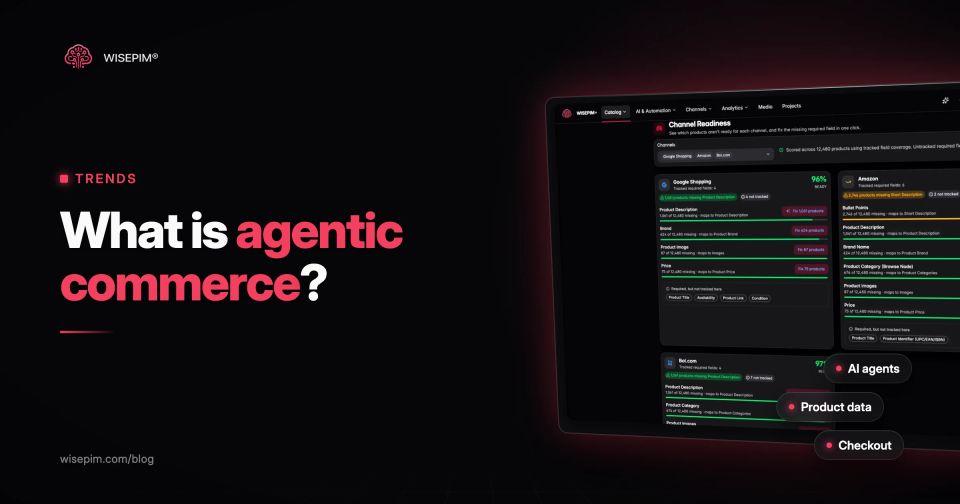
Agentic commerce is buying and selling in which an AI agent acts for the shopper. The agent researches products, compares offers, builds a cart and, within limits the shopper sets, completes the purchase by exchanging data with merchant systems through protocols instead of clicking through a website. The shopper states the goal ("trail running shoes, size 43, wide fit, under EUR 140, delivered by Friday"); the agent does the searching, filtering and, increasingly, the checkout.
That is the difference with a shopping chatbot or AI search: those answer, while an agent acts. In practice, on the publish date of this guide, the answering part runs at scale and the acting part is still narrow. AI assistants recommend products to very large audiences every day, but autonomous checkout runs with selected merchants, mostly in the US, and in March 2026 OpenAI stepped back from its own in-chat checkout to let merchants use their own. This guide explains the levels of autonomy, the protocols behind them, the product data an agent needs, and the risks merchants should weigh.
Agentic commerce compared with chatbots, AI search and conversational commerce
The terms overlap, so it helps to separate them by what the software is allowed to do:
- Conversational commerce: a shopper chats with a brand, often on WhatsApp or a site chat, and a person or bot answers. The shopper still does the buying.
- AI search and AI shopping assistants: ChatGPT, Google's AI Mode, Perplexity or Copilot read the web and merchant feeds and answer with a shortlist. The shopper clicks through and buys.
- Agentic commerce: the agent also takes actions: it assembles a cart, applies a discount, pays with a delegated credential or places a repeat order, and the merchant receives an order it did not see a human place.
For a merchant, the first two mainly change how you are found. The third changes who your customer's representative is at the moment of purchase. Our dictionary entry on agentic commerce has a shorter definition for quick reference.
Six levels of autonomy, from subscriptions to agent-to-agent buying
Agentic commerce is not one switch from human to machine. McKinsey describes an "automation curve" with six levels of delegation, and stresses that higher is not automatically better: shoppers stop at the level that fits the category (McKinsey, January 2026). The same article estimates that, even in moderate scenarios, AI agents could mediate $3 trillion to $5 trillion of global consumer commerce by 2030. Each level asks something different from merchants:
Six levels of agentic commerce and what each asks of merchants
| 0 | Programmed convenience | Subscriptions and scheduled refills; rules-based, no AI judgment | Reliable recurring orders |
|---|---|---|---|
| 1 | Assist | Researches and compares; the human decides and buys. Where most AI shopping assistants are today | Verifiable, structured attributes and claims an agent can compare |
| 2 | Assemble | Returns a purchase-ready basket that resolves trade-offs such as price against delivery date | Inventory, prices, shipping promises, promotions and return rules exposed cleanly, ideally through APIs or feeds |
| 3 | Authorize | Executes within rules the shopper sets, such as buying sneakers once they drop below $80 at a trusted store | Payment authorization that can be limited, audited and reversed |
| 4 | Autonomize | Manages standing goals, such as keeping household essentials under a monthly budget | Machine-readable loyalty, substitution and service rules |
| 5 | Networked autonomy | Shopper agents negotiate with merchant agents; still emerging | Policies and guarantees an agent on the other side can read and trust |
The practical reading: groceries and household refills will climb the curve fastest, while luxury goods and milestone purchases tend to plateau low on the curve, with the agent as researcher and the human making the final call. Most catalogs sit in between, so plan for level 1 and 2 first.
Walking through one agent-led purchase, field by field
Take the trail shoe request from the opening. Here is what an agent reads from each merchant at each step, and where a thin product record drops out:
- Interpret the goal: category trail running shoes, size EU 43, width wide, budget EUR 140, deadline Friday. The agent now has five filters.
- Discover candidates: from merchant feeds and crawled product pages. A shoe with no width attribute, or with width hidden in a description sentence, fails the filter even if it is the best fit.
- Check the offer: price and currency, sale price and dates, stock for that specific variant (size 43, wide), and a delivery promise. A parent product marked in stock while the wide 43 is sold out produces a failed order later.
- Compare and explain: drop, weight, terrain, waterproofing and review summaries. Attributes with consistent units (grams, millimeters) make the comparison; marketing adjectives do not.
- Build the cart and pay: at level 2 the shopper approves the cart; at level 3 a pre-signed mandate lets the agent pay within the EUR 140 limit.
- Hand the order to the merchant: the merchant accepts or declines it, takes payment through its own provider and stays the merchant of record, handling delivery, returns and support.
Every step depends on structured product data. The agent never sees your homepage banner; it sees the fields.
The protocols behind agentic commerce and who backs each
Protocols are the shared rules that let any agent talk to any merchant without a custom integration for each pair. The main ones on the publish date of this guide:
Agentic commerce protocols and who backs them
| Agentic Commerce Protocol (ACP) | OpenAI and Stripe | 2025-09-29 | Launched to power Instant Checkout in ChatGPT (OpenAI). On March 24, 2026, OpenAI said the first version of Instant Checkout did not offer the flexibility it wanted, let merchants use their own checkout, and extended ACP to carry product feeds and promotions for discovery (OpenAI) |
|---|---|---|---|
| Universal Commerce Protocol (UCP) | Google, co-developed with Shopify, Etsy, Wayfair, Target and Walmart | 2026-01-11 | An open standard covering discovery, buying and post-purchase support. It powers checkout in AI Mode in Search and the Gemini app, with the retailer as seller of record (Google). Our Universal Commerce Protocol explainer covers its capabilities in detail |
| Agent Payments Protocol (AP2) | Google Cloud | 2025-09-16 | Signed mandates: an Intent Mandate records what the shopper asked for or pre-authorized, and a Cart Mandate records the exact items and price approved (Google Cloud). This is the mechanism that makes level 3 possible |
| Trusted Agent Protocol | Visa, with Cloudflare | 2025-10-14 | Lets approved agents identify themselves to merchants with cryptographic signatures, so a store can tell a shopping agent from a malicious bot (Visa) |
Model Context Protocol (MCP) and Agent2Agent (A2A) are general standards for connecting agents to tools and to each other, and Google says UCP is compatible with both and with AP2. Two more signals of direction: Google introduced Universal Cart in May 2026, a cart that works across merchants and Google services (read our Universal Cart analysis), and OpenAI repositioned ChatGPT around discovery with merchant-owned checkout. For a store owner, the takeaway is that you do not pick one protocol. You keep one clean product record and publish it through whichever feeds and platforms your customers' agents use.
Product data an agent needs before it will recommend or buy
McKinsey's summary for level 1 is blunt: verifiable data beats marketing gloss. Google said in January 2026 that it was adding dozens of new Merchant Center attributes for conversational commerce, such as answers to common product questions, compatible accessories and substitutes. Use this checklist against one category of your catalog:
- Identifiers: a valid GTIN per variant (check digit verified), brand and MPN. Without them an agent cannot match your offer to the same product elsewhere. See how GTIN, UPC and EAN differ.
- Typed attributes: size, width, material, weight, dimensions, compatibility, each in its own field with consistent units. A spec in a description sentence is a spec most agents will miss.
- Variants: one row per size and color with its own stock, price and image, linked by a group ID.
- Offer data: price, currency, sale price with start and end dates, and availability that matches the buy button.
- Delivery and returns: shipping cost, delivery time per country, return window in days and whether returns are free. Agents at level 2 resolve exactly these trade-offs.
- Product answers: the questions customers ask your service team, written as short question and answer pairs, plus compatible accessories and substitutes.
- Category: a consistent category tree mapped to the channel taxonomy, so filters work.
- Policies in text: loyalty terms, warranty and substitution rules on crawlable pages, not only in a PDF.
Readiness is measurable per channel. The share of products that meet a channel's required fields is what we call channel readiness, and it is the simplest number to track while you close gaps. For ChatGPT specifically, our guide on how to rank in ChatGPT turns this list into steps.
Agentic commerce risks merchants should weigh
Losing the direct customer relationship
When an agent sits between you and the shopper, you see fewer page views and less behavioral data, and the agent may compare you on price first. Both ACP and UCP keep the merchant as merchant or seller of record, which protects order data, returns and support, but brand discovery happens inside someone else's interface.
Telling shopping agents from bad bots
Visa reported in October 2025 that AI-driven traffic to US retail websites had risen more than 4,700% over the past year, and named the problem directly: bot detection can block legitimate agent purchases (Visa). Block too much and agents cannot buy from you; block too little and scrapers and fraudsters get through. Review bot-protection rules with agent traffic in mind before you assume a drop in conversions is a demand problem.
Wrong data turns into wrong orders
A human shopper who sees a mismatch hesitates. An agent acting at level 3 may buy. A wrong width, a stale price or an out-of-stock variant shown as available becomes a cancellation, a return or a dispute. The cost of bad product data rises with the level of autonomy.
Unsettled liability and disputes
If an agent buys the wrong item within its mandate, who pays: the shopper, the agent platform, the payment network or the merchant? Signed mandates in AP2 and tokenized credentials create an audit trail, but the rules for disputes are still being written by networks and platforms. Keep order confirmation emails, return terms and cancellation windows clear and fast for agent-placed orders.
Betting on one platform's timeline
OpenAI's own course correction on Instant Checkout shows how fast the surface changes. Build for the parts that hold across platforms: complete product data, accurate offers and feeds you can generate for any channel. Avoid one-off integrations you cannot maintain.
A 90-day agentic commerce readiness plan
A 90-day agentic commerce readiness plan
- 1
Weeks 1 to 2
Audit your top category
Pick your top category by revenue. Audit identifiers, attributes, variant stock and offer data against the checklist above, and count products that fail.
- 2
Weeks 3 to 4
Check crawl access
Check crawl access for AI search crawlers in robots.txt and your bot protection, and confirm price and stock render in the HTML.
- 3
Weeks 5 to 8
Fill the gaps
Fill the missing attributes, fix GTINs, split variants and add delivery and return data. Write question and answer pairs from service emails.
- 4
Weeks 9 to 10
Generate AI channel feeds
Generate feeds for the AI channels you can join (Google Merchant Center today; ChatGPT, Copilot and Perplexity where your market and platform allow).
- 5
Weeks 11 to 12
Lock in quality and test
Set validation rules so new products cannot go live incomplete, and run a monthly prompt test of how assistants describe your products.
WISEPIM covers the product data side of this plan: AI enrichment fills attributes, descriptions, translations and categories, Quality Guard blocks incomplete records before export, Channel Readiness shows which products miss required fields per channel, and Feed Hub generates ChatGPT Shopping, Copilot and Perplexity feeds next to Google Shopping. The agentic commerce readiness page shows how the pieces connect.
