Keystone pricing means setting the retail price at double the wholesale cost. That is a 100% markup on cost, and it leaves a 50% gross margin on the selling price: a candle bought for EUR 9.00 sells for EUR 18.00, and EUR 9.00 of every sale is gross profit (Shopify).
Retailers use keystone because it is fast and consistent: one multiplier prices a whole delivery. The catch is everything the multiplier leaves out. Freight and duties, payment and marketplace fees, VAT, discounts and competitor prices all sit outside the formula, so a store can price everything at keystone and still keep far less than half of each sale. Below you will find the formula, what triple keystone means, a worked example that follows one product from the supplier invoice to a marketplace payout, and how to run keystone as a rule per sales channel.
The keystone formula: cost times two
Three lines cover the arithmetic:
- Retail price = cost × 2
- Markup on cost = (price − cost) ÷ cost = 100%
- Gross margin on price = (price − cost) ÷ price = 50%
Markup and margin describe the same EUR 9.00 against a different base, which is why "keystone" is quoted as both 100% and 50%. If those two numbers still get swapped in your team, the markup vs margin guide has the conversions, and the markup calculator does them for any price.
Two details decide whether the 50% is real. First, which cost you double. Classic retail doubles the supplier's price per unit, but a webshop that imports also pays freight, duties and handling, so the honest base is the landed cost. Second, VAT. Keystone works on prices excluding VAT. In the Netherlands the standard rate is 21% (Business.gov.nl), so the EUR 18.00 candle has a shelf price of EUR 21.78 including VAT, and the EUR 3.78 difference goes to the tax authority, not into your margin.
Where the name comes from is not well documented. Explanations range from the keystone at the top of an arch to Pennsylvania, the Keystone State, and none of them has a solid source. The practice itself is simply the retail habit of doubling the wholesale price.
Keystone, triple keystone and the multipliers in between
Triple keystone usually means about three times the wholesale cost. Shopify describes it as a practice of jewelry and luxury retailers, where brand reputation and perceived value carry prices well above cost (Shopify). The term is used loosely, though, so when a supplier or a buying group says "triple keystone", ask for the multiplier as a number.
Price multipliers with markup and gross margin
| 1.5× | EUR 15.00 | 50% | 33.3% | Below keystone |
|---|---|---|---|---|
| 2× | EUR 20.00 | 100% | 50.0% | Keystone |
| 2.5× | EUR 25.00 | 150% | 60.0% | Above keystone |
| 3× | EUR 30.00 | 200% | 66.7% | Triple keystone (usual meaning) |
| 4× | EUR 40.00 | 300% | 75.0% | Well above keystone |
The bottom of the table matters as much as the top. Shopify's guide to wholesale and retail puts typical retail markups at 30% to 50% on the wholesale price (Shopify), well under keystone. In categories where shoppers compare the same branded product across stores, a 100% markup is often more than the market will pay.
One product from supplier invoice to marketplace payout
Take a ceramic plant pot, 20 cm, glazed, bought from a supplier in Portugal. All figures here are illustrative and exclude VAT unless stated.
- Supplier price: EUR 12.00 per pot. Keystone gives EUR 24.00, or EUR 29.04 including 21% VAT.
- Landed cost: freight, handling and inbound packaging add EUR 1.50 per pot, so the real cost is EUR 13.50. Margin at EUR 24.00 drops from 50% to 43.8%.
- Own webshop: a payment fee of 2% on the VAT-inclusive price (EUR 0.58) and EUR 0.80 for the shipping box leave EUR 9.12, or 38.0% of the net price.
- Marketplace: a 15% commission on the VAT-inclusive price plus EUR 1.00 per item costs EUR 5.36, and with the same EUR 0.80 box, EUR 4.34 is left. That is 18.1%.
Gross margin left on a keystone-priced plant pot
Illustrative example| Category | Margin on the net price |
|---|---|
| Keystone on supplier price | 50% |
| After landed cost | 43.8% |
| Own webshop, after fees | 38% |
| Marketplace, after fees | 18.1% |
To keep 40% on the marketplace, solve for the price instead of doubling the cost. With fees of 15% on the VAT-inclusive price plus EUR 1.00, the pot needs a net price of at least EUR 36.56 (EUR 44.24 including VAT): fees of EUR 7.64, cost EUR 13.50, box EUR 0.80 and EUR 14.62 left, which is 40.0%. That is about three times the supplier price, or 2.7 times the landed cost. On that channel, a keystone with the same intent is closer to 2.7× landed cost than to 2×.
Where keystone leaves too little margin
The worked example already shows the main cases. Keystone runs thin when:
- The cost base is the supplier price, not landed cost. Imports with freight and duties lose several margin points before the first sale.
- The channel takes a percentage. Marketplace commission and payment fees come out of the price, not out of the markup.
- The item is cheap. Fixed costs per item or per order, such as packaging and per-item fees, weigh far more on a EUR 6.00 product than on a EUR 60.00 one.
- It goes on sale. At 30% off, the EUR 24.00 pot sells for EUR 16.80 and keeps EUR 3.30 over its EUR 13.50 landed cost, which is 19.6% before any fee.
- Returns are common. Every return adds handling and shipping costs that the formula never counted.
For a full view of what each order really leaves, work out the contribution margin per channel rather than trusting the multiplier.
Where keystone asks too much
Keystone can also overshoot. Branded products with a GTIN appear side by side in price comparison sites and shopping ads, and a store at twice its cost competes with stores that bought cheaper or accept a thinner margin. For high-ticket branded items such as appliances and consumer electronics, shoppers compare prices across many stores, so check whether a 100% markup is realistic before applying it. And products with a strong perceived value, such as handmade or exclusive goods, may sell well above keystone, which is the reason triple keystone exists.
In each of those cases, keystone is a starting point to check against competitor prices and what shoppers will pay, not the answer.
Keystone as one setting of cost-plus pricing
Keystone is cost-plus pricing with the markup fixed at 100%. Everything that applies to cost-plus applies to keystone: it is easy to explain and audit, it moves prices with costs automatically, and it ignores demand. Two ways of writing the same rule are worth separating, because they behave differently when costs change.
- Markup on cost: price = cost × (1 + markup). Keystone is a markup of 100%. A cost increase of EUR 1.00 raises the price by EUR 2.00.
- Target margin on price: price = cost ÷ (1 − margin). Keystone is a target margin of 50%, which gives the same price. The form matters when you target something else: a 40% margin means dividing by 0.60, a 66.7% markup on cost.
Teams that think in margins should set prices from the margin form, because converting in your head is where the 50% markup that was meant to be a 50% margin comes from. A 50% markup leaves 33.3%, so a whole range priced that way earns half the gross profit per item that a 50% margin would have given.
Keystone and the manufacturer's suggested retail price
The wholesale price a brand charges decides what a stockist keeps at the brand's MSRP. A wholesale price around half the suggested retail price lets a stockist sell at MSRP and keep roughly 50%, which is keystone. Check that against your own numbers, because one detail often gets lost. In the EU, consumer prices include VAT, while your cost and margin are calculated without it.
Take a lamp with a wholesale price of EUR 45.00 and an MSRP of EUR 99.00. That looks like more than keystone, but EUR 99.00 includes 21% VAT, so the net price is EUR 81.82. The margin at MSRP is 45.0%, below keystone, and that is before landed cost and fees. For the same EUR 45.00 lamp, keystone including Dutch VAT would be EUR 108.90.
Brands and wholesalers work the same arithmetic backward. If stockists expect keystone at MSRP, the wholesale price excluding VAT can be at most half the MSRP excluding VAT, and the brand's own margin has to fit below that. A brand that cannot make its numbers work at half the net MSRP either raises the MSRP or accepts that stockists earn less than keystone, and both choices should be made before the price list goes out.
Running keystone as a pricing rule per channel
Applied by hand, keystone breaks down as soon as you sell in more than one place, because each channel has its own fees. A rule per channel keeps the intent and adjusts the multiplier. In practice that means three settings per channel: the cost base, the markup or target margin, and a floor that stops a price going below a minimum margin after fees.
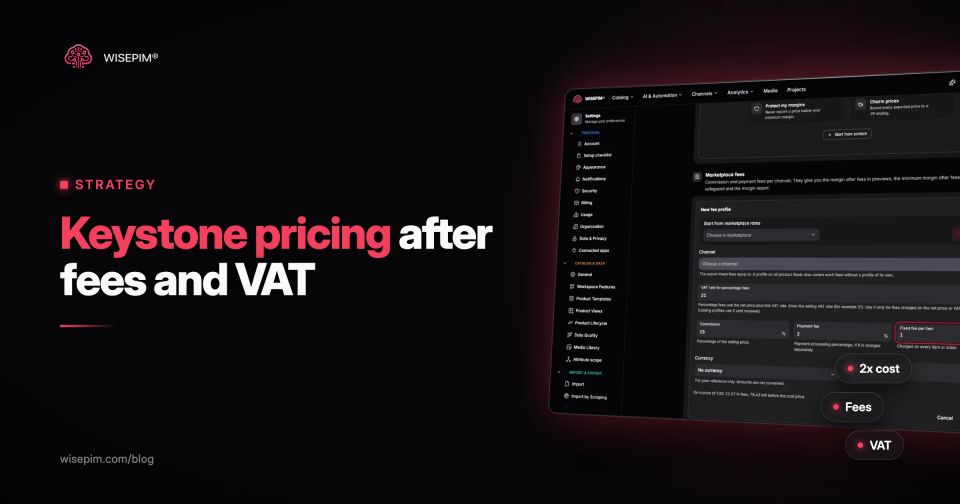
In WISEPIM, channel pricing works this way. A cost plus markup rule of 100% is keystone, and a cost plus margin rule targets a margin on the selling price instead, which suits the marketplace case above. Rules change the price at export per channel and leave the price stored in WISEPIM untouched. A fee profile per channel holds the commission, payment fee and fixed fee per item, with the VAT rate that percentage fees are charged on, and a safeguard can hold every exported price above a minimum margin after those fees. Rounding to charm prices such as .95 or .99 runs after the calculation, as covered in psychological pricing.
Three channel rules that start from keystone
For the plant pot range, with landed cost as the cost price, a setup could look like this (illustrative):
- Own webshop: cost plus markup 100%, rounded to a .95 ending. EUR 27.00 rounds to EUR 26.95, because charm rounding turns an exact whole amount into the charm price just below it.
- Marketplace: cost plus margin 40% with a minimum margin after fees of 25%. The margin rule gives EUR 22.50, the floor lifts it to EUR 25.51, which keeps 25% after the 15% commission and the EUR 1.00 fee. The shipping box is not part of a fee profile, so leave room for costs like it in the floor you choose.
- B2B price list: cost plus markup 30% for resellers, who apply their own keystone on top.
Cost-based rules need a cost price on the product, and by default they skip products that have none, so a missing cost leaves the stored price in place instead of exporting a price calculated from zero. Before switching a rule on, find the products without a cost price and fill them in, ideally with landed cost rather than the supplier price.
Before you price a range at keystone