Cost plus pricing sets a selling price by taking the cost of one unit and adding a fixed percentage on top. The formula is price = unit cost x (1 + markup). A product that costs EUR 13.40 to land in your warehouse, priced at cost plus 80%, sells for EUR 24.12 before VAT. Retailers, wholesalers and manufacturers use it because it needs only one input you already know, guarantees a gross profit on every unit, and scales to thousands of SKUs with a single rule.
The method is simple; the inputs are where it goes wrong. The "cost" has to be the full cost of getting the product sellable (purchase price plus freight, duty and handling), the percentage has to be clearly a markup on cost or a margin on price, and in e-commerce the same cost needs a different plus per channel, because a marketplace takes a commission that your own webshop does not pay. This guide works through all three with one product, then covers when cost plus fails and how to run it as rules instead of a spreadsheet.
Cost plus pricing formula: markup on cost or margin on price
There are two ways to write the "plus", and they give different prices from the same number:
- Cost plus markup: price = cost x (1 + markup). Cost EUR 13.40 at 80% markup gives EUR 24.12.
- Cost plus margin: price = cost / (1 - margin). Cost EUR 13.40 at a 45% target margin gives EUR 24.36.
- Markup to margin: margin = markup / (1 + markup). An 80% markup is a 44.4% margin.
- Margin to markup: markup = margin / (1 - margin). A 45% margin is an 81.8% markup.
Both are cost plus pricing. Buyers tend to think in markup, because they build the price up from a supplier invoice; finance tends to think in margin, because it judges how much of each euro of revenue stays. Pick one per price list and label the column. If someone says "we price at cost plus 40", ask whether that is 40% of cost or 40% of the price: the second is a 66.7% markup. Our guide to markup vs margin has the full conversion table, and the markup calculator does the arithmetic for a single product.
The textbook version, as AccountingTools describes it for a manufacturer, adds up direct materials, direct labor and allocated overhead, then multiplies by one plus the markup. A retailer or webshop does not make anything, so its cost is what it pays to get a unit on the shelf. That is the next section.
What goes into the cost before you add the plus
Cost plus pricing is only as good as the cost it starts from. For a product you buy and resell, the cost per unit is the landed cost: everything you pay until the unit is in stock and ready to sell.
- Purchase price from the supplier invoice, per sellable unit (not per carton).
- Inbound freight and insurance, allocated per unit.
- Import duty and customs clearance fees, if you import from outside your customs area. Import VAT is usually reclaimable and stays out of the cost.
- Inbound handling: receiving, labeling, repacking into retail units.
- Currency effects if you pay in another currency: use the rate you actually paid, not today's rate.
Our landed cost guide shows how to allocate shared freight by value, weight or volume. Costs that grow with each sale rather than each unit bought (payment fees, outbound shipping, marketplace commission, returns) do not belong in the cost base. They differ per channel and per order, so they are handled in the channel price below and in contribution margin, not baked into one cost number.
Worked example: a two-person camping hammock
An illustrative example that runs through the rest of this post. A webshop imports a two-person camping hammock. The supplier invoice says EUR 11.40 per unit. Freight and insurance add EUR 1.10 per unit, import duty EUR 0.50 and inbound handling EUR 0.40. The landed cost is EUR 13.40.
Now the most common cost plus mistake. The buyer applies the house markup of 80% to the invoice price, because that is the number on the screen: 11.40 x 1.80 = EUR 20.52 before VAT. The intended result was an 80% markup, a 44.4% margin. Against the real cost of EUR 13.40, EUR 20.52 is a 34.7% margin. Nothing on the product page looks wrong. The missing ten points show up months later in the profit report, on every product priced the same way.
One cost, three channels: webshop, marketplace and wholesale
With the right cost in place, the hammock goes to three channels. All prices below are illustrative; the VAT rate is the Dutch standard rate of 21% (Business.gov.nl). Margins are calculated on the price excluding VAT, because the VAT is not yours.
Own webshop, target margin 45%. Net price = 13.40 / (1 - 0.45) = EUR 24.36, which is EUR 29.48 including VAT. Nobody sells at EUR 29.48, so it rounds up to EUR 29.95. Net of VAT that is EUR 24.75, a gross profit of EUR 11.35 and a 45.9% margin. Rounding down to EUR 28.95 would have dropped the margin under target, so always round up from a cost plus result or recheck the margin after rounding.
Marketplace, at the same price. Say the marketplace charges 15% commission on the price the customer pays plus EUR 1.00 per item (illustrative; look up your own category, for example with the bol commission calculator). At EUR 29.95, fees are EUR 5.49. What is left is 24.75 - 5.49 - 13.40 = EUR 5.86, a 23.7% margin after fees. The cost plus price that worked for the webshop roughly halves the profit here.
To keep a 30% margin after fees, solve for the price instead: net price x (1 - 0.30) - commission = cost + fixed fee. That gives EUR 33.60, rounded up to EUR 33.95: net EUR 28.06, fees EUR 6.09, profit EUR 8.57, a 30.5% margin after fees. Whether shoppers on that marketplace will pay EUR 33.95 is a market question that cost plus cannot answer, which is the point of the last sections.
Wholesale to a retailer, cost plus 35%. B2B prices are quoted excluding VAT: 13.40 x 1.35 = EUR 18.09, a 25.9% margin for you. The retailer then has to sell it. If they match your webshop at EUR 29.95 (EUR 24.75 net), their margin is (24.75 - 18.09) / 24.75 = 26.9%. A retailer that needs 40% would have to buy at EUR 14.85, leaving you a 9.8% margin. A 35% wholesale markup and a EUR 29.95 shelf price cannot both hold; that conflict is covered in our wholesale vs retail guide.
The camping hammock priced cost plus in three channels
| Webshop | 45% margin, rounded up | EUR 29.95 | EUR 24.75 | EUR 0.00 | EUR 11.35 | 45.9% |
|---|---|---|---|---|---|---|
| Marketplace, webshop price | Same price as webshop | EUR 29.95 | EUR 24.75 | EUR 5.49 | EUR 5.86 | 23.7% |
| Marketplace, repriced | 30% margin after fees | EUR 33.95 | EUR 28.06 | EUR 6.09 | EUR 8.57 | 30.5% |
| Wholesale | Cost plus 35% markup | n/a (B2B, excl. VAT) | EUR 18.09 | EUR 0.00 | EUR 4.69 | 25.9% |
The webshop figure is a gross margin: payment fees, packaging and outbound shipping still come off it. Marketplaces often handle part of that, so comparing a webshop gross margin with a marketplace margin after fees flatters the webshop. Compare channels on contribution margin before you decide one is more profitable.
Where each euro of the hammock price goes, per channel
Illustrative example| Category | Landed cost | Marketplace fees | VAT | Profit |
|---|---|---|---|---|
| Webshop EUR 29.95 | €13.40 | €0 | €5.20 | €11.35 |
| Marketplace EUR 33.95 | €13.40 | €6.09 | €5.89 | €8.57 |
| Wholesale EUR 18.09 | €13.40 | €0 | €0 | €4.69 |
Repricing when a supplier raises the cost
Cost plus pricing reacts to cost changes, and that is its biggest practical advantage. Suppose the hammock supplier raises the invoice price by EUR 0.90, so the landed cost becomes EUR 14.30.
- Price left at EUR 29.95: the margin falls from 45.9% to 42.2% without anyone deciding it should.
- Cost plus 45% margin recalculated: net price EUR 26.00, EUR 31.46 including VAT, rounded up to EUR 31.95, a 45.8% margin.
- Wholesale at cost plus 35%: moves from EUR 18.09 to EUR 19.31 on its own, which you then have to announce to the retailer.
This only works if the cost field is updated when the invoice changes. Shopify's own profit reports show the risk: they report profit only for products that had a cost recorded at the time of sale, and the Cost per item field is static data (Shopify Help Center). A cost entered once at launch and never touched again turns a cost plus price into a fixed price with an outdated margin.
Decide in advance how often you recalculate: on every purchase invoice, monthly, or when the cost moves by more than a set percentage. Repricing on every small cost wobble makes prices jump around for shoppers; never repricing defeats the point.
Four situations where cost plus pricing gets the price wrong
The weakness of cost plus is that it looks inward. It knows what the product cost you and nothing about what a buyer will pay or what a competitor charges. AccountingTools lists the same drawbacks: it ignores competition and builds on historical costs that may differ from current ones. In a catalog, that shows up in four places.
- The product is worth more than its cost suggests. A replacement part that keeps a machine running, a niche size nobody else stocks, a bundle with a well-written setup guide. Cost plus leaves money on the table here; price from the value to the buyer and use cost plus only as the floor.
- Competitors set the market price. For a branded product sold by ten shops, shoppers compare the same GTIN side by side. If your cost plus price is EUR 3 above the market, you sell nothing; if it is EUR 3 below, you gave away margin for no extra sales.
- One markup for every price point. The same 80% that suits the hammock makes a EUR 1.20 carabiner a EUR 2.16 item that shoppers would happily buy at EUR 4.95, and can push a premium tent above every competitor. Different price bands, brands and categories need different percentages.
- The shelf price is fixed by someone else. With an MSRP, a retailer's price point or a marketplace's buy box, the price is given and the question is how much margin it leaves. That is cost plus in reverse: start from the price, subtract fees and cost, and check the margin.
The practical answer used by most catalog sellers is a hybrid: cost plus as a floor per product, market or value pricing on top where you have the information, and a minimum margin that no price may drop below.
Where cost plus pricing is still the right default
Cost plus fits best where the cost is known, the catalog is large and there is no single market price to follow:
- Distributors and wholesalers with long tails. Thousands of SKUs, many with no direct competitor price, priced from a supplier list plus a markup per brand or category. Our B2B pricing guide shows how a cost-based floor combines with customer group discounts.
- Private label and made-to-order products. No identical product exists elsewhere, so the cost is the only hard number.
- New products without sales history. Cost plus gives a defensible launch price that you adjust once you see sell-through.
- Contract pricing with an open book. Some B2B contracts let the buyer see the cost and agree the markup. Public procurement is stricter: US federal rules forbid the cost-plus-a-percentage-of-cost system of contracting outright (FAR 16.102), because a percentage fee rewards the contractor for higher costs.
Checks before you switch on cost plus prices
Running cost-plus rules per channel, brand and category in WISEPIM
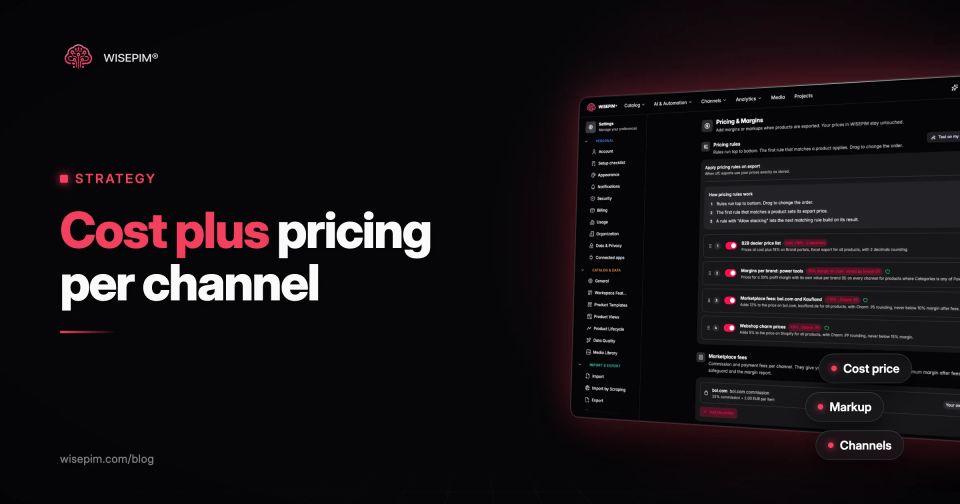
Doing all of this in a spreadsheet means a price column per channel, recalculated by hand when a cost changes. In WISEPIM, pricing rules per channel calculate the export price for a shop, a marketplace connection, a CSV or Excel export, a feed or a Brand Portal, while the price stored in the catalog stays as it is. Cost plus markup and cost plus margin are two of the five calculation types, next to percentage markup, fixed amount and fixed price.
A rule can give each brand, supplier, product family or category its own value, which answers the one-markup-for-everything problem from the previous section without writing a rule per brand. Rounding (two decimals, whole numbers, charm .99 or .95) and safeguards come with each rule: a minimum and maximum price, a maximum change against the current price and a minimum margin. On channels that have a fee profile (commission, payment fee and a fixed fee per item), a minimum margin after fees raises any price that would leave less than your target after the channel takes its share, which is the marketplace calculation from the hammock example done per product. A fee profile also carries a VAT rate for percentage fees: set it to 21 and commission is calculated on the price including VAT, the way the marketplace in the hammock example charges it.
By default a cost-based rule skips products that have no cost and flags them, so a missing cost never exports as zero plus 80%. The engine treats stored prices and costs as excluding VAT and adds no VAT to the result, so on a channel that expects prices including VAT a cost plus rule exports a net price. Check the output with Test on my products before you switch a rule on. That preview shows the before and after price, margin and margin after fees for a sample of your catalog. Keep the cost field filled with landed cost.