Machine translation post-editing (MTPE) is the work of a human who reviews and corrects machine-translated text until it meets an agreed quality level. There are two recognized levels: light post-editing, which fixes errors of meaning so the text is accurate and understandable, and full post-editing, which also fixes style, terminology and fluency so the result reads like a good human translation.
For a product catalog, the practical answer is to split the work by risk. Translate everything with AI under a glossary and fixed rules, give full post-editing to the fields where an error costs money or creates liability (safety warnings, legal text, best-seller titles, category texts), and check the long tail with structured samples instead of reading every one of 5,000 descriptions. This post covers the two levels, what reviewers should look for in product content and a sampling workflow. For everything around translation, such as prices, VAT display and market-specific sizes, see the guide to ecommerce localization.
Light and full post-editing as ISO 18587 describes them
The reference standard is ISO 18587:2017, "Translation services, Post-editing of machine translation output, Requirements". According to ISO, it sets requirements for the process of full, human post-editing of machine translation output and for post-editors' competences, and it is meant for translation service providers, their clients and post-editors. Providers can be certified against it, and a summary by the Association of Translation Companies notes that the standard describes full post-editing as reaching quality comparable to human translation while keeping a distinction between light and full post-editing.
A revision is under way. ISO lists the 2017 edition as "to be revised" and expects it to be replaced by ISO/DIS 18587, retitled "Post-editing of non-human translation output" to take in AI and LLM translation. In Germany, DIN's public enquiry on the draft (ISO/DIS 18587:2026) runs until 11 November 2026. Until the new edition is published, the 2017 version remains current. The ATC summary says the revised text lets customer specifications decide which level applies, which matches how catalog teams already work.
Industry guidelines draw the same line in plainer words. A comparative study of post-editing guidelines by Hu and Cadwell notes that TAUS frames the two levels as "good enough" quality and "human translation quality", and that light post-editing guidelines focus on the accuracy of the message while grammar, syntax and style are not a big concern.
Light vs full post-editing for product content
| Goal | Accurate and understandable | Reads like a good human translation |
|---|---|---|
| Fixes | Wrong meaning, wrong numbers, missing text, broken terms | Everything in light, plus style, tone, terminology consistency and fluency |
| Leaves alone | Awkward but correct phrasing | Nothing that a native reader would notice |
| Typical product content | Long-tail descriptions, low-traffic meta descriptions | Safety and legal text, best-seller titles, category texts, ad copy |
| Who does it | Native speaker who knows the products | Qualified translator or experienced native editor |
| Effort per product | Low | Close to a fresh review of every sentence |
Which catalog fields get which level
Most catalogs have three tiers. Write the tiers down before translating, because the decision drives cost and turnaround more than the engine does.
- Full post-editing. Safety warnings, instructions and age labels; warranty and legal wording; product names and titles of your top sellers; category and landing page texts; any claim you could be held to ("waterproof to 10,000 mm", "dishwasher safe"). Under the EU General Product Safety Regulation, an online offer must show warnings and safety information in a language consumers can easily understand, as decided by the member state (Article 19, see the GPSR guide). That text is not a place for "good enough".
- Light post-editing or sampled review. Long-tail descriptions, short descriptions and meta descriptions of products that sell a few units a year. Errors here are cheaper and rarer once the rules are right, so a sample tells you whether the batch is sound.
- Translate once, review fully. Attribute values from a controlled list: colors, materials, fits, "machine washable at 30 °C". The same 200 values appear on thousands of products, so one reviewed translation of the list fixes them everywhere. Reviewing them product by product wastes the effort.
- Do not translate, but check. GTINs, SKUs, model numbers, brand names and numeric specs. They should pass through unchanged, and an automated check can confirm that.
Search wording deserves its own line. A correct translation can still be the wrong word for search: the term shoppers type in German or Dutch may differ from a literal rendering of the English title. The multilingual SEO guide covers per-language keyword research for titles and meta fields.
Glossaries and do-not-translate lists come before the first run
Most post-editing effort in catalogs repeats the same few corrections: a brand name translated, a product line name split into words, a technical term rendered three different ways. Every one of those belongs in the rules before translation, not in the editor's queue after it. Four lists cover most of it:
- Keep-as-is terms. Brand names, product line and model names, trademarked materials and technologies, and certification names. Add your own brand first.
- Preferred translations. Terms with one approved rendering per language, such as "merino wool" or "hydrostatic head". Add a context note when a term is ambiguous: "case" means a phone case in accessories and a carton of 12 in your wholesale range.
- Category-scoped terms. The same source word translated differently per category. "Sleeve" is part of a shirt in apparel and a protective cover in electronics.
- Field rules. Character limits for titles and meta fields, whether units are converted or kept, formal or informal address per language.
The DeepL vs Google Translate comparison covers how glossaries work in each engine. Whatever the tool, the source is the same: a spreadsheet of term, context and approved translation per language, maintained by someone who owns it.
What a post-editor checks in product content
General post-editing guidelines are written for prose. Product content fails in more specific ways, mostly in numbers, names and fixed text. Give reviewers this list rather than "check the translation".
Product translation review checklist
Ask reviewers to classify each correction rather than only fix it: critical (wrong number, missing warning, wrong product meaning), major (wrong term, broken markup, wrong unit format) or minor (style, word order). The classification is what tells you whether a batch passes and which rule to change.
One kids' helmet listing through a light and a full pass
An illustrative example shows where the two levels part ways. The English source for a children's bike helmet reads: "TrailBuddy Junior kids' bike helmet with LED rear light, size S (48 to 54 cm), 230 g. Adjust the fit with the dial at the back. Warning: do not use this helmet for climbing or other activities where a child could get caught." A first AI translation into Dutch came back with four problems:
- The warning lost "or other activities" and now only mentions climbing. Critical: a safety sentence is incomplete.
- "TrailBuddy Junior" became "PadMaatje Junior". Major: a product line name was translated.
- The text addresses the reader as "u", while the store writes "je" everywhere else. Minor for meaning, visible to every Dutch shopper.
- The title says "fietshelm voor kinderen" where Dutch shoppers search for "kinderfietshelm". Minor for meaning, relevant for search.
A light pass fixes the first two and stops: the warning is complete and the name is right, so the text is accurate. A full pass also switches to "je", rewrites the title around the term shoppers use and smooths the word order. Because this product sits in the safety tier, it gets the full pass. A sock in the long tail with only the third issue would ship after a light pass, and the formality rule would be fixed in the settings so the next batch gets it right.
The more useful outcome is what changes in the rules. "TrailBuddy" goes on the keep-as-is list, "je" becomes the Dutch language setting, and the missing clause prompts a check on every product that carries a warning text, not only this helmet.
A sampling workflow for AI-translated catalogs
Reading every translated description defeats the point of machine translation, and reading none is how a wrong unit ends up on 800 products. A sample sits between the two: review a small, deliberately mixed set until it is clean, then translate the rest under the same rules and keep checking smaller samples per batch.
Sample, fix the rules, then scale
- Pick a representative sample per language. Mix categories, brands, best sellers and long-tail items, and include the hard cases on purpose: products with spec tables, safety text, many units, ambiguous terms and HTML-heavy descriptions.
- Translate the sample under the final rules. Same glossary, same field settings, same engine and mode you plan to use for the full run, or the sample measures the wrong thing.
- Review with the checklist and classify every correction. Record the field, the error type and the severity. A reviewer note on why a term is wrong is worth more than the corrected text alone.
- Turn repeated corrections into rules. A term fixed twice becomes a glossary entry; a tone complaint becomes a language-level instruction; a unit error becomes a field rule. Then regenerate and review the same sample again.
- Set the bar and scale. Run the full catalog once a sample comes back with no critical errors and only the minor errors you accept for that tier. Give tier 1 fields their full post-edit, and spot-check a fresh random sample from each new batch, supplier or category.
- Keep the loop running. Corrections made after publishing, from customer service or a market manager, go into the same glossary and rules so they do not recur. The dictionary entry on product content translation management describes the roles and hand-offs around this loop.
Run the loop separately for each target language. Errors are rarely shared: German may struggle with compound product terms and title length, French with gender agreement on attribute values, Dutch with formality and with English loanwords that shoppers do or do not use. A sample that is clean in one language says nothing about the next, and the rules you add (glossary entries, formality, field limits) are mostly per language too.
Running the sample review inside WISEPIM
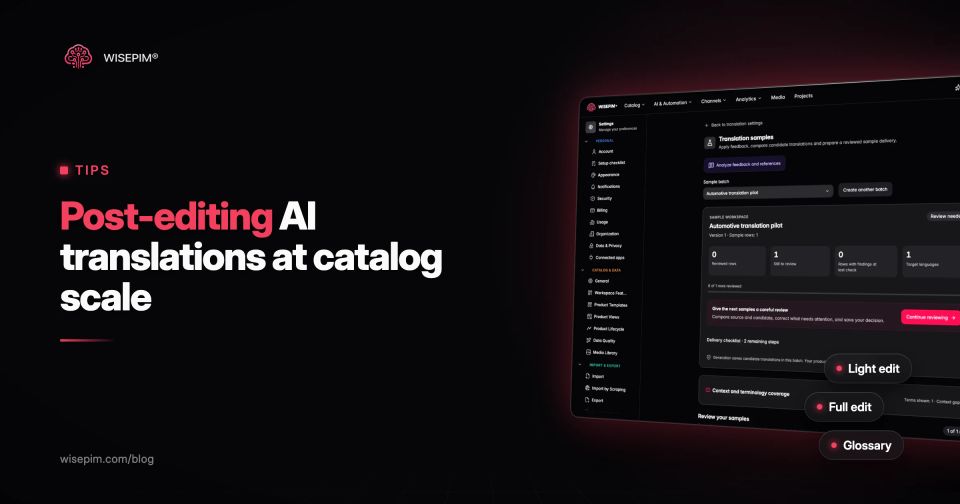
WISEPIM translates product content with LLM-based AI, at 95%+ accuracy, under project rules: a dictionary with approved and keep-as-is terms (scoped to categories when needed), per-field instructions and length limits, language overrides for formality, and a unit setting that keeps, converts or shows both. The Translation samples workspace runs the sampling step: you choose up to 50 products (and at most 300 product, field and language combinations), up to six target languages and the fields to review (name, descriptions, SEO title, description and keywords), and candidates are generated into the batch without touching live product content.
Automated checks flag the mechanical errors from the checklist: a source number missing in the translation, a changed measurement unit, a protected term that disappeared, altered HTML, text over the field limit, the wrong writing system and terminology that ignores the dictionary. Reviewers approve, request changes or reject each row, and a saved correction protects that row from regeneration. As the screen itself notes, fluency, tone and factual completeness still need a human. Feedback from an outside reviewer can be uploaded as a file through Ingest feedback and turned into suggested dictionary and settings changes. The AI product translation page covers the full translation workflow.