White label products are generic products a manufacturer makes once and sells to many resellers, who each put their own brand on them. Private label products are made to one retailer's specification and sold only under that retailer's brand. In both cases the reseller's name is on the box, but only private label gives you a product that no competitor can sell.
The difference also decides how much of the product data becomes yours. As soon as a product carries your brand, you are the party that issues its barcode, you are the brand in every feed, and under EU product safety law you are treated as its manufacturer. This guide explains both models with examples, weighs the pros and cons for a reseller, and lists the product data you must own before the first listing goes live.
White label and private label, defined with examples
Both models separate the company that makes a product from the company that sells it. What differs is who decides what the product is, and how many sellers end up with the same thing.
White label: one generic product, many sellers' logos
A white label manufacturer designs a standard product, keeps the formula or the tooling, and lets resellers choose a logo, a label and sometimes a color or packaging option. The same 750 ml insulated steel bottle can appear under ten shop brands, identical apart from the print. Typical white label categories are supplements, skin care basics, phone cases and chargers, coffee capsules, candles and printed promotional goods.
The appeal is speed. Minimum order quantities are usually lower because the factory runs one product for many buyers, and the specification, test reports and safety documents already exist. The catch is that a shopper who searches the product type can find the same item from several sellers and compare on price alone.
Private label: a product built to your specification
In a private label deal, the retailer or brand sets the specification: the recipe, the materials, the dimensions, the packaging, sometimes the test standards. A contract manufacturer produces it only for that retailer. Supermarket own-brand ranges are the classic case, and many online brands work the same way: a sock brand that specifies 80% merino wool, reinforced heels and its own size grid is selling private label even if it never owned a factory.
Private label costs more to start. You pay for development, samples and often higher minimum quantities, and you carry the risk of a product that does not sell. In return you get a product competitors cannot list, a margin you control, and a brand that builds value over time.
White label vs private label at a glance
| Who sets the specification | The manufacturer | The retailer or brand |
|---|---|---|
| Exclusivity | Same product sold to many resellers | Made for one seller only |
| Customization | Logo, label, packaging options | Formula, materials, design, packaging |
| Time to market | Weeks, product already exists | Months, includes development and samples |
| Upfront cost and MOQ | Lower | Higher |
| Price competition | High, identical items are easy to compare | Lower, no identical item elsewhere |
| Product data you own | Brand, GTIN, own content; specs come from the maker | All of it, including specs and safety documents |
One more model sits next to these two. A reseller of branded goods sells another company's brand unchanged, with the maker's barcode and the maker's name. That is ordinary retail or distribution (our wholesale vs retail guide covers the data side of both), not white label, and the brand owner keeps responsibility for the core product data. The rest of this guide is about what changes when your own brand goes on the product.
Pros and cons of each model for a reseller
When white label is the better first move
- Pro: fast launch. The product, its specs and its test reports exist, so you can list within weeks of choosing a supplier.
- Pro: low risk. Smaller first orders make it cheap to test a category before you commit to developing your own product.
- Pro: documents to start from. A good white label supplier hands over specifications, safety data and instructions you can adapt.
- Con: no moat. Another shop can buy the same item tomorrow, so reviews, content and service are your only difference.
- Con: limited control. If the factory changes a component or discontinues the product, every reseller is affected and you may not hear about it first.
When private label pays off
- Pro: a product only you sell. Shoppers cannot find the identical item elsewhere, which weakens pure price comparison.
- Pro: margin and specification control. You decide where to spend (better materials) and where to save (simpler packaging).
- Pro: brand equity. Reviews and search demand accumulate on your brand, not the factory's.
- Con: development cost and stock risk. Samples, tooling, testing and larger minimum orders tie up cash before the first sale.
- Con: full responsibility. You are accountable for the product's safety, labeling and documentation, which is the data work covered next.
Many resellers start with white label in a new category and move the best sellers to private label once demand is proven. Plan the product data for that move from day one: if your SKUs, GTINs and attribute structure are yours from the start, switching suppliers later changes the source of the goods, not your whole catalog.
The moment your logo goes on, you own the product data
Whether you buy white label or commission private label, a product sold under your brand needs four kinds of data that you, not the factory, are responsible for.
GTINs from your own GS1 company prefix
The barcode follows the brand. The GS1 General Specifications (section 4.2.3.1) say that the party that warrants the trade item declarations assigns the GTIN, and they name among those parties the retailer, importer or wholesaler that sells the item under its own brand name. In practice, a product under your brand gets a GTIN from your own GS1 company prefix or individually licensed GTINs, not the number the factory uses for its own branded version or for another reseller.
In examples we use GS1's demonstration GTIN 9506000134352. If that were your private label bottle, the factory would print your number on your label, your feeds would send it in the gtin field, and marketplaces would match listings to it. Our GTIN vs UPC vs EAN guide explains the formats and where to license numbers, and the EAN and GTIN validator checks the check digit before a typo reaches a feed. Handmade and some custom products can qualify for an exemption instead; the GTIN exemption guide covers when that applies.
Brand field: your brand, not the factory's
Every channel has a brand field, and on white label goods it is often filled with the factory name copied from a supplier sheet. Google's brand attribute documentation tells merchants to submit their store name as the brand for private-label products, including products manufactured by someone else and rebranded by you. Use one exact spelling across the brand field, product titles, images and packaging, so filters, feeds and marketplace brand registries all see the same name.
Keep the factory's details in their own fields rather than deleting them: a supplier field and the supplier's article number are what your buyers need to reorder. The MPN is a different case: for a product under your brand, the model number shoppers see should be yours.
Manufacturer details and GPSR safety information
Under the EU General Product Safety Regulation, a manufacturer is anyone who has a product designed or manufactured and markets it under their own name or trademark (Regulation (EU) 2023/988, Article 3(8)). Article 13 adds that anyone who places a product on the market under their name or trademark is deemed a manufacturer and takes on the manufacturer's obligations. For a reseller this applies to both white label and private label: once your brand is on it, you carry the duties the factory would otherwise have.
Those duties have a data side. Article 9 requires your name, registered trade name or trademark, postal and electronic address on the product, packaging or accompanying document, plus a type, batch or serial number, instructions and safety information in the consumer's language, and technical documentation kept for 10 years. Article 19 requires online offers to show the manufacturer's name and contact details, product identification with a picture, and the warnings and safety information. Our GPSR guide goes through each field; the short version for this article is that the manufacturer fields in your catalog must now hold your company, and the factory's test reports become part of your own file.
Content and images nobody else is using
A white label supplier sends the same description and the same packshots to every reseller. Publishing them unchanged puts your listing next to identical copies on other sites and marketplaces, and the photos still show the factory's logo or a blank label. Write your own titles and descriptions, shoot or render images with your label on the product, and add the details the factory text skips, such as your size guide, care instructions in your tone, and what is in the box under your packaging.
One insulated bottle record, three ways
Here is how the same illustrative 750 ml steel bottle looks in a catalog when you resell the maker's brand, when you buy it white label, and when you commission it as private label. The fictional maker is called Kestrel Drinkware and the reseller brand is Nordpeak.
Who supplies each field for one bottle
| Brand | Kestrel | Nordpeak | Nordpeak |
|---|---|---|---|
| GTIN | Kestrel's GTIN | Nordpeak GTIN, e.g. 9506000134352 | Nordpeak GTIN, e.g. 9506000134352 |
| MPN or model | Kestrel model number | Nordpeak model number | Nordpeak model number |
| Manufacturer (GPSR) | Kestrel | Nordpeak | Nordpeak |
| Supplier and supplier SKU | Kestrel, KD-750 | Kestrel, KD-750 | Kestrel, NP-750-01 |
| Capacity, material, insulation hours | From Kestrel | From Kestrel, checked by you | Your specification |
| Description and images | Kestrel content allowed | Your own content | Your own content |
| Safety and care information | Kestrel's documents | Adapted from Kestrel, issued by you | Written and issued by you |
Two fields stay with the factory in every column: the supplier name and the supplier SKU. Keeping them is what lets purchasing reorder the right item and lets you prove where a batch came from if a safety question comes up.
Five data handover traps when switching to your own brand
- The factory GTIN survives. It was imported with the supplier file and nobody replaced it, so your listing is matched to another seller's product.
- The old brand hides in text. The brand field says Nordpeak, but the title, alt text or a spec line still says Kestrel.
- The manufacturer address is the factory's. Under GPSR the name and contact details on the product and in the listing must be yours as the brand, yet the supplier file often still holds a factory outside the EU.
- Supplier copy goes live unchanged. The same description appears on several shops, and claims the factory makes about tests or certificates are published without the documents to back them.
- Specs are not re-checked after a supplier switch. A new factory's bottle holds 720 ml, not 750 ml, and the old capacity stays in your feed.
Before your first own-brand listing goes live
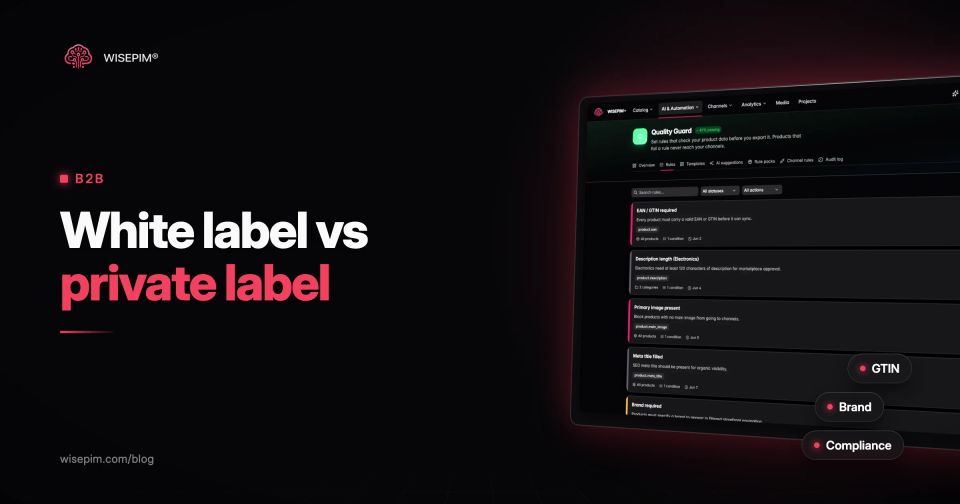
Taking over a supplier's catalog under your brand in WISEPIM
Most of this work is a bulk edit on a supplier file. In WISEPIM you import the supplier's data, keep the supplier fields, set the brand to your own across the range in one bulk edit, and import your own GTIN per SKU from your GS1 list. Manufacturer contact details for GPSR can live in their own attributes. If the supplier publishes its catalog through a Brand Portal, you can import it into your own project in one click instead of mapping a spreadsheet. Quality Guard rules such as EAN / GTIN required and Brand required, set to Block, then hold back any product that still has an empty or invalid value before it is exported, and AI enrichment drafts your own descriptions and translations from the specifications for you to review. For brands growing a private label range, the PIM for brands page shows the full setup.