IOSS, the Import One-Stop Shop, is the EU VAT scheme that lets a seller charge EU VAT at checkout on goods shipped from outside the EU to consumers, in consignments with an intrinsic value of up to EUR 150. The seller declares that VAT in one monthly IOSS return, and the parcel clears customs without import VAT because its IOSS number is in the customs declaration. The scheme started on 1 July 2021, when the EU stopped exempting imports up to EUR 22 from VAT, and it is optional, according to the Commission's VAT e-commerce explanatory notes.
An IOSS number is the 12-character VAT identification number a seller, marketplace or intermediary gets after registering, and it always starts with IM. Without one, the buyer pays VAT when the parcel arrives, usually to the carrier and usually with a handling fee on top. Since 1 July 2026 there is also a separate customs question: low-value parcels now pay a flat EUR 3 customs duty per item, whether or not IOSS is used. This guide covers both, plus the product data each one depends on. It explains the rules as published on 14 October 2026 and is not legal or tax advice; check your own case with an adviser.
Which sales the Import One-Stop Shop covers
IOSS applies to a distance sale of imported goods when all four conditions hold:
- The goods ship from outside the EU at the moment of sale, from a non-EU warehouse, supplier or fulfillment center. Stock already in an EU warehouse is not an import sale.
- The consignment's intrinsic value is EUR 150 or less. Intrinsic value is the price of the goods themselves, excluding transport and insurance when those are shown separately on the invoice.
- The seller ships, or arranges the shipping, to a consumer or other non-VAT-registered buyer in an EU country.
- The goods are not excise goods such as alcohol or tobacco. IOSS also cannot be used when low-value goods are bought or shipped together with excise goods.
The EUR 150 limit applies per consignment, not per product. A customer who buys three items at EUR 60 in one order normally receives one EUR 180 consignment, which falls outside IOSS. The explanatory notes tell marketplaces to presume that goods one customer orders at the same time from the same seller form one consignment, and customs can treat a deliberately split consignment as one. Splitting an order to stay under the threshold is not the intended use.
Does IOSS apply to this order?
What an IOSS number looks like and who receives one
The EU's OSS registration page gives the format as IMxxxyyyyyyz: the letters IM, then ten characters, 12 in total. An intermediary first receives its own intermediary number in the format INxxxyyyyyyz, which is not a VAT number, and then gets a separate IM number for each seller it represents. The number goes into the customs declaration so the goods can be released VAT-free. The explanatory notes say to pass it only to the parties in the supply chain that need it for customs release, so share it with the carrier or customs agent that declares your parcels and do not publish it on your website.
Who registers, and where, depends on where the business is established:
- EU-established sellers register directly in their own EU country and may appoint an intermediary.
- Non-EU sellers must appoint an intermediary established in the EU and register through it. The intermediary files the returns and pays the VAT, but the seller stays jointly liable.
- Sellers in a country with an EU VAT mutual assistance agreement may register directly for sales shipped from that country. When the notes were published, Norway was the only such country.
- Marketplaces and platforms that act as deemed supplier register once and use a single IOSS number for all the sales they facilitate.
Marketplaces as deemed supplier for low-value imports
When a non-EU seller sells low-value imported goods through a marketplace or platform, the EU treats the platform as if it had bought and resold the goods itself. This deemed supplier rule makes the marketplace responsible for charging the VAT at checkout, filing it in its own IOSS return and passing its IOSS number to the declarant. The seller does not charge VAT on those sales, but has to give the platform correct data: the ship-from country, the price and a description that supports the right VAT rate.
The rule covers consignments up to EUR 150 imported from outside the EU, and also any sale of goods already in the EU by a non-EU seller through a platform. Sales above EUR 150 imported through a platform are not covered by the deemed supplier rule, so VAT on those is handled at import. A seller using both a marketplace and its own webshop therefore runs two VAT routes at once: the platform's IOSS for marketplace orders, and its own IOSS registration or the import route for webshop orders.
Selling without IOSS: VAT at import and carrier fees
IOSS is optional. A seller who does not register leaves the VAT to be collected at import. The explanatory notes describe the result: the person liable for import VAT, typically the customer, pays it on arrival, and the company declaring the parcel may add a clearance fee. The Commission also notes that customers used to VAT-inclusive prices may refuse a parcel that arrives with charges. Dutch customs explains the same for consumers on its page about extra costs on foreign orders (in Dutch): VAT, import duties and the carrier's handling fee, collected by the carrier rather than by customs.
Three ways VAT is collected on an imported parcel up to EUR 150
| IOSS | Seller or marketplace, in the IOSS return | At checkout | Rate of the destination country for that product | Only if the seller charges it to the buyer at checkout |
|---|---|---|---|---|
| Special arrangements | Postal operator or carrier, monthly to customs | On delivery | Member states may allow the standard rate for all goods | Yes |
| Standard import procedure | Declarant at import, recovered from the buyer | On delivery | Rate for that product in the import country | Yes |
The EUR 3 customs duty on low-value parcels since 1 July 2026
Keep VAT and customs duty apart, because the 2026 change touched only the duty. Until 30 June 2026, consignments up to EUR 150 were exempt from customs duty. Council Regulation (EU) 2026/382 of 11 February 2026 removed that relief and replaced it with a temporary flat customs duty of EUR 3 per item, applied from 1 July 2026 until 1 July 2028, as the Commission's guidance on the temporary flat fee explains. After that date, normal duty rates apply by product. The regulation asks the Commission to assess by 1 December 2027 whether the EU Customs Data Hub will be ready in time and, if not, to propose extending the flat duty.
- It applies to every distance sale up to EUR 150, whether the VAT went through IOSS, the special arrangements or the standard procedure.
- Preferential origin only helps outside IOSS. Goods that qualify for a trade agreement rate can claim it in a full H1 declaration, but only when the VAT was not collected through IOSS; every IOSS import pays the EUR 3 duty, according to the Commission's customs guidance.
- It is charged per item, not per parcel. An item is goods sharing the same tariff classification, description and, where declared, origin. Five identical T-shirts are one item and EUR 3; a T-shirt and a watch are two items and EUR 6. In practice customs systems apply it per declaration line, whatever the quantity on that line.
- The declarant pays it, meaning the seller, the IOSS holder or its representative. The Commission describes it as a duty on businesses, not a tax on consumers.
- VAT treatment differs by route. Under IOSS the duty is not part of the VAT base unless the seller charges it to the buyer at checkout; under the other two routes it always is, according to the Commission's VAT addendum on the EUR 3 duty.
EU low-value import milestones
1 July 2021
The EUR 22 VAT exemption ends and IOSS opens for consignments up to EUR 150.
VAT is due on all commercial imports, whatever their value.1 July 2026
The EUR 150 customs duty relief ends; a temporary flat duty applies per item.
Applies to IOSS, special arrangements and standard import alike.- 3
1 November 2026
A EUR 2 handling fee per item is expected, also above EUR 150; product identifiers become mandatory.
The fee's delegated act was still under scrutiny in October 2026. - 4
1 July 2028
The flat EUR 3 duty ends and goods pay the normal rate for their tariff code.
Linked to the EU Customs Data Hub; the date may be extended.
The next step is already announced. The Commission's customs guidance on the EUR 3 duty and the handling fee, version of 5 October 2026, says a Union handling fee of EUR 2 per item is expected to apply from 1 November 2026, also to distance sales above EUR 150. On the publication date of this article it was not yet in force, so treat the date as expected, not final.
Worked example: a hoodie and a cap shipped from the US to Utrecht
An illustrative order from a US-based apparel shop that prices in euros, to a consumer in the Netherlands, shipped in October 2026. The shop lists prices excluding VAT and shows shipping separately:
- Goods: one knitted cotton hoodie at EUR 60 (HS heading 6110, jerseys and pullovers) and one textile cap at EUR 25 (heading 6505, hats and headgear, in HS chapter 65). Shipping: EUR 8.
- Intrinsic value: EUR 85. Shipping is shown separately, so it is excluded. The consignment qualifies for IOSS.
- With IOSS: the shop charges Dutch VAT of 21% at checkout on the full sale of EUR 93, which is EUR 19.53, and the buyer pays EUR 112.53. The parcel clears VAT-free.
- Customs duty: the hoodie and the cap have different tariff headings, so they are two items: 2 x EUR 3 = EUR 6, owed by the declarant at import. If the shop adds that EUR 6 to the checkout price, the VAT base becomes EUR 99 and the VAT EUR 20.79.
- Without IOSS: the shop charges no VAT. At delivery the buyer pays import VAT of 21% on goods, shipping and duty, EUR 99 in total, so EUR 20.79, typically plus the EUR 6 duty and the carrier's own handling fee.
Add a second identical hoodie and the duty stays at EUR 6, because the same goods on one declaration line count as one item. Add a EUR 70 jacket and the consignment reaches EUR 155, above the IOSS limit, so the whole parcel goes through import VAT. You can check net and gross amounts with the free VAT calculator, but the rate has to come from the destination country, not your own.
Product data an IOSS seller needs on every SKU
IOSS and the EUR 3 duty both run on product data. A missing or vague field turns into a wrong VAT rate, a wrong duty count or a parcel held at customs. These are the fields to keep complete per product, and per variant where they differ:
- HS code: six digits in a low-value H7 declaration and a 10-digit TARIC code in a full H1 declaration. The code also decides how many EUR 3 items a parcel holds. Our guide on how to find an HS code walks through the classification steps.
- Customs description: a plain trade description ("men's knitted cotton hoodie"), not a marketing name. Customs uses it next to the code.
- Country of origin: needed for full declarations and preferential treatment, and it travels with the HS code.
- Price excluding VAT, per currency: the basis for the intrinsic value and for the EUR 150 test on the whole basket.
- VAT rate category per destination country: standard or reduced, because IOSS charges the rate of the country the goods go to. In the Netherlands, for example, books and magazines are taxed at 9% instead of 21%, according to Dutch customs.
- Weight and packed dimensions: carriers use them to quote shipping and to build the declaration.
- Excise flag: marks products such as alcohol that can never go through IOSS, and baskets that contain them.
If you sell through Shopify, the same HS code and country of origin also drive the duty estimates at checkout, as covered in our Shopify Markets post. For the wider picture of selling across borders, including returns and languages, see the guide to international ecommerce.
Keeping HS codes and customs fields filled before parcels ship
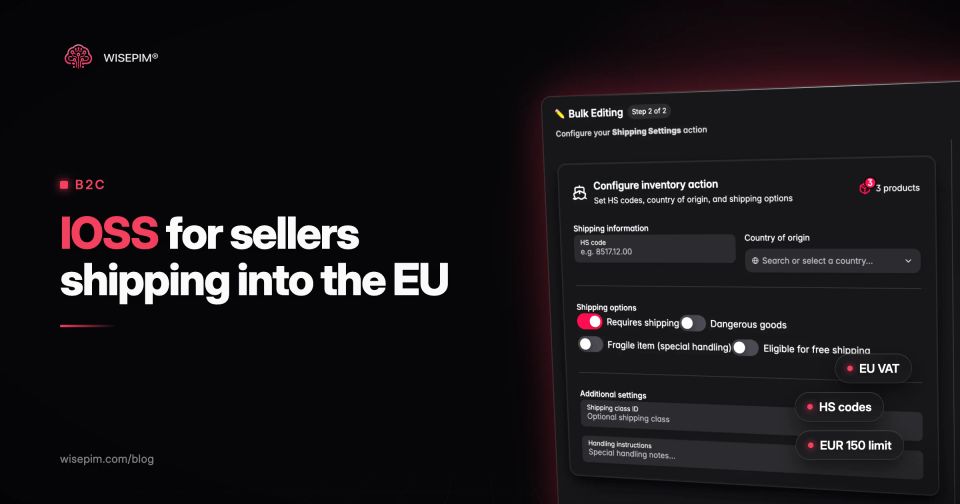
WISEPIM is not a VAT, customs or IOSS tool: it does not register you, file returns or file declarations. It keeps the product side right. Products have dedicated HS code and country of origin fields, and bulk operations set them for a filtered selection at once. To find codes, the free HS Code Finder suggests a code from a product title and description, based on the official EU and US nomenclature; it is a suggestion, not a binding classification. The HS code entry in our taxonomy guide explains how the code is built from chapter to subheading.